LinkedIn outreach method note
Expandi Cost Isn't the Problem: What Revenue Ops Teams Should Evaluate in Email Validation
· Julian Hartwell
-
Expandi cost is transparent, and I'd still rather see it upfront
-
Cold email platform features: what actually matters
-
Expandi LinkedIn automation is the shiny part, not the real part
- What should revenue operations teams evaluate in email validation?
-
The unavoidable objection: "we'll verify separately"
-
So what should you actually pay for?
Most B2B teams buy prospecting tools backwards. I did, too. Then, in March 2024, a client called at 4:30 PM with a 48-hour deadline to invite 2,000 prospects to a roundtable. The addresses came from a tool that labelled them "verified." A quick test showed a 15% bounce rate before we even hit send. That was the moment I stopped trusting fancy demos and started auditing the email validation underneath.
In my role coordinating outbound campaigns for B2B service teams when time is the only budget, I've handled enough last-minute pushes to know where things break. They don't break in the LinkedIn automation. They break in the contact data.
Expandi cost is transparent, and I'd still rather see it upfront
Let's start with Expandi cost, because that's the first question I get from RevOps leaders. Expandi publishes per-seat pricing on its site. You can see the plans before a sales call. That alone puts it ahead of tools that quote you only after a discovery call and a handshake.
But transparent pricing has a second layer. In this category, "cost" also includes the hidden operational expense of bad data. That means credits for email verification, enrichment add-ons, API connectors, and the time your ops person burns stitching systems together. I've been burned enough by low sticker prices that I now ask one question before I evaluate any cold email platform: what's NOT included?
"The vendor who lists all fees upfront—even if the total looks higher—usually costs less in the end."
That's not just a slogan. When I've compared prospecting platforms side by side, the one with the lower monthly price often ended up more expensive once verification and integrations were added. Expandi looked more like an all-in tool from the start, and the cost has been predictable since.
Cold email platform features: what actually matters
I don't care about template galleries or subject line rotators. Those are table stakes. When someone asks what cold email platform features I evaluate, I narrow it down to four:
- Email finder with multi-source intelligence. If a tool only guesses one format and hopes for the best, you'll lose valid contacts.
- Email verification built into the workflow, not redirected to a third party. If verification lives in another system, you'll skip it when you're rushing.
- Enrichment that fills in the context you need for personalization. If the tool doesn't include it, you'll be pulling data from a separate vendor.
- API and webhook access. This is how the platform becomes part of an agent-native workflow connecting CRM, enrichment, and your AI agents without CSV shuffling.
Expandi's full prospecting stack covers those four pieces: LinkedIn automation, email finder, verification, and enrichment in one platform. For me, the API access matters most. If I can't push a contact to Salesforce with a webhook, it's not really an ops tool, it's just a front-end.
Expandi LinkedIn automation is the shiny part, not the real part
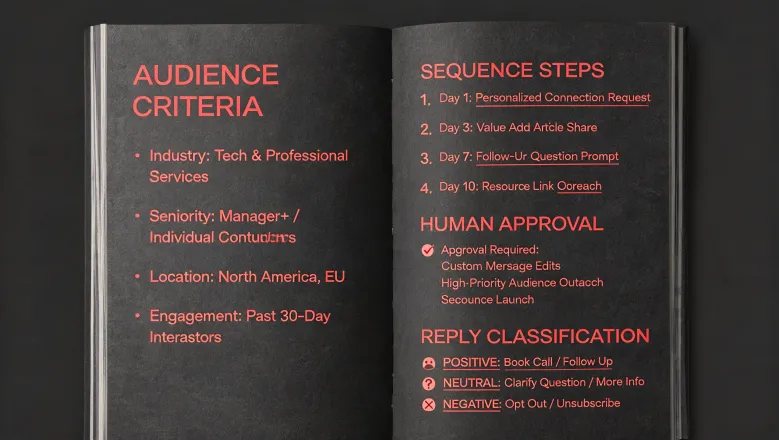
Let's talk about Expandi LinkedIn, because that's how most people discover it. The LinkedIn automation side includes connection requests, follow-ups, visits, and the kind of workflow that saves SDRs from repetitive clicking. Good. But I've learned not to judge a platform by its LinkedIn features alone.
In my first year managing outbound, I made the classic mistake: I chose a tool because its LinkedIn automation looked powerful. The email extraction was an afterthought. If I remember correctly, that first batch had a 12% bounce rate, and the sender score took a few weeks to recover. It didn't matter how many connection requests went out. The follow-up cadence died because the addresses were dirty.
LinkedIn automation fills the top of the funnel. Email validation protects everything after it. Expandi happens to do both, but I'd still tell a team with one week to evaluate: spend more of that week on validation than on sequences.
What should revenue operations teams evaluate in email validation?
Here's the question that should be on every RevOps checklist.
Syntax is not validation. A regex check only tells you whether the address looks like an email. It doesn't tell you if the mailbox exists, if the domain receives mail, or if the address belongs to a spam trap. At minimum, a credible email validation process should include:
- Syntax and format checks
- Domain existence and MX record verification
- SMTP response checks, not just a ping
- Catch-all domain detection
- Role account detection like info@ or sales@
- Disposable email domain blocklists
- Spam-trap flagging
Don't just ask "do you verify emails?" Ask exactly how. Does verification run at list upload, at send, or both? Are catches rechecked when you send a second campaign? What happens to suppressed addresses? Those details matter more than a dashboard showing "94% deliverability."
Authentication awareness is part of validation
Sending infrastructure also matters. SPF (RFC 7208), DKIM (RFC 6376), and DMARC (RFC 7489) are the authentication standards every cold email platform should respect. Validation isn't the same as authentication, but if a tool says an email is valid and the domain has no MX record, that domain is not accepting mail no matter how well the syntax is formatted.
You don't need to quote RFC numbers to a vendor. But you should expect them to understand how their validation affects deliverability. In a RevOps evaluation, that willingness to talk about actual email infrastructure is more useful than a pretty sequence builder.
The unavoidable objection: "we'll verify separately"
I hear the counterargument a lot: "We'll use Expandi for LinkedIn and a dedicated email verification tool for the list." Fine. That can work in a stable program with generous timelines.
But in the scenarios I live in, separate is a problem. Separate tools mean separate exports, separate syncs, separate CSV filters. When a client calls needing a campaign for tomorrow, you don't want to troubleshoot a connector or compare two vendors' server logs at midnight. The integration is part of the cost.
Maybe that tradeoff makes sense for your team. My experience is based on B2B service companies with compressed timelines. If you're running small, high-intent enterprise lists, a dedicated verification provider might be justifiable. But if lead generation speed matters more than list perfection, integrated verification beats a fragile pipeline.
So what should you actually pay for?
Expandi cost isn't the lowest I've seen. It's also not the highest. The reason I recommend it for these use cases is the absence of nickel-and-diming around the core stack. If I can see per-seat pricing, verification is included, enrichment is part of the platform, and I can connect it to the rest of my revenue ops stack, that's a tool I can defend to a CFO without a spreadsheet full of add-ons.
I won't pretend Expandi is the only option. But the next time someone shows you an automation tool, ask what it does after the meeting request is sent. Because the platform you need isn't the one with the most LinkedIn buttons. It's the one with transparent cost and clean, validated data flowing into the sales conversation.
The bottom line: don't let Expandi LinkedIn automation distract you from the email validation question. And don't choose a tool on sticker price. The best tool has no hidden fees and no bad addresses.

Julian Hartwell
Julian Hartwell is an independent B2B sales intelligence analyst covering contact databases, company data, decision-maker profiles, direct dials, prospect lists, and buying signals. He applies the ISO/IEC 25012 data-quality model while examining field accuracy, coverage, freshness, duplicate rate, match confidence, and source transparency. His evidence-led guides help revenue teams compare prospecting platforms, define acceptable data thresholds, and build account lists that support reliable territory planning and outreach.