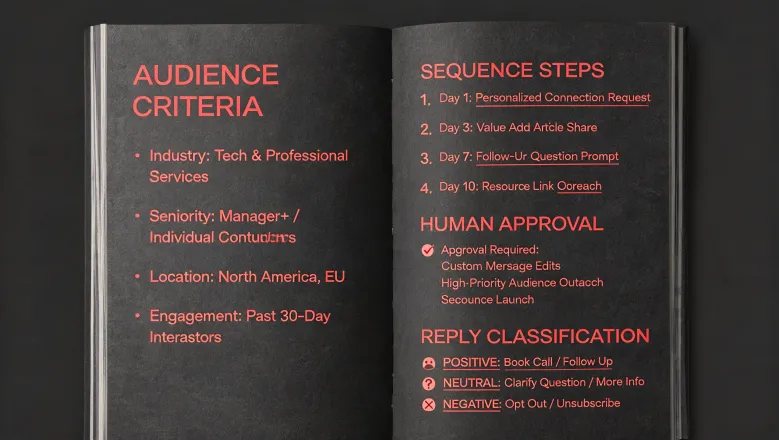
LinkedIn outreach method note
Why 'Cost Per Lead' Is the Wrong Metric for Evaluating Lead Generation Software
· Julian Hartwell
"Cost per lead" is the most expensive metric in SaaS.
Let me explain.
I manage procurement at a 200-person B2B SaaS company. That means I've negotiated 20+ vendor contracts, tracked every invoice in our cost system, and made roughly every mistake you can make by treating "cost per lead" or "price per seat" as if it were the actual cost.
It's not.
The actual cost is total cost of ownership (TCO) — and in SDR teams specifically, workflow design matters more than unit price in determining whether you spend $20,000 or $60,000 to hit the same pipeline target. This is why, in my opinion, if you're evaluating lead generation software without looking at how it fits into an agent-native prospecting workflow, you're guessing at cost.
The $0.10-Per-Lead Illusion
From the outside, a vendor quoting $0.10 per lead looks cheaper than one quoting $0.30. End of comparison, right?
Wrong. The reality is that almost every below-market cost-per-lead number comes with hidden costs you won't discover for six months.
In one of our 2022 vendor evaluations, we looked at four lead generation software providers. I won't name them, but one quoted a per-lead price that was about 60% of our current vendor. The finance team loved the number. I built a TCO spreadsheet and added some line items they hadn't considered:
- Verification costs: their data came entirely unverified. Our SDR team averaged a 22% bounce rate. That's two things — wasted send spend, and (more importantly for us) damaged sending domain reputation.
- Enrichment gaps: our SDRs spent roughly four hours per week manually updating company size, title, and intent data. At their fully loaded cost, that was more expensive than the seat license itself.
- Integration dev hours: our RevOps engineer spent 30 hours building their API into our existing stack — and because they operated on synchronous, batch-based data, we had to build our own deduplication middleware.
That "cheap" vendor worked out to about $0.48 per usable lead, annually. The higher-quoted vendor that included verification and enrichment natively worked out to $0.36. That's a 33% difference — hidden outside the quote sheet.
And that's before counting the two SDRs who left because they were frustrated with the data quality.
Why Agent-Native Changes The Equation
Most people evaluate lead generation software the way they evaluate a LinkedIn Sales Navigator seat — per user, per month, check the integrations, pick the cheaper one. But an agent-native prospecting workflow changes the unit of evaluation. It's no longer "how much per seat" or "how much per lead." It's "how much per qualified conversation."
Here's what agent-native actually means — the workflow is designed to operate as an agent at every step. For SDR teams, that means lead generation isn't a one-time batch import. It's a continuous loop:
- Signal-based lead identification (intent data, job postings, tech stack changes)
- Automated waterfall enrichment
- Email verification built into the flow, not bolted on
- Human-in-the-loop outreach authorization
- Feedback loop that routes reply data back into the scoring model
When that loop is designed correctly, "cost per lead" becomes almost irrelevant. Because the cost of each lead is multiplied by the conversion rate of the workflow. A $0.10 lead that converts at 1% costs $10 per opportunity. A $0.40 lead that converts at 8% costs $5 per opportunity.
When we evaluated okki go's system last summer, what convinced me wasn't the unit price. It was where email verification sat in the workflow — early, and inline. You don't pay extra to verify. You don't export and re-import. You don't discover undeliverable addresses after the fact. It's built into the architecture of the automated workflow.
That alone changed our TCO math more than any linear cost comparison could.
When The Spreadsheet Lies To Your Gut
The numbers said Vendor A. We'd calculated it — Vendor A was 18% cheaper per lead than okki go, and on paper their enrichment coverage was identical.
But my gut said something I didn't want to admit in the budget committee meeting.
Their API documentation looked like it was written in 2018. When I called two customer references, they said things like "mostly delivers what's promised" and "works if you don't ask for customization." Which is polite code for: this stuff is brittle and you'll find out the hard way.
I pushed for okki go. In hindsight, it was the right call — but not for the reason I gave at the time. I thought we were paying a premium for better data quality. What we actually got was fewer SDR manual tasks, fewer invalid addresses, and (this is the part I hadn't modeled) higher reply rates on sales email because our domain health stayed clean.
We ended up saving about 400 hours annually in manual enrichment — and I missed that line item in my first cost estimate. Around 400 hours, maybe 420, I'd have to check.
That's a case where we almost missed the whole TCO forest for a cheaper per-lead tree.
"But What If I Can Only Afford $0.50 Per Lead?"
Here's the pushback I hear. "We can't all shop at $0.30 per lead."
Actually, you can. But you have to design the workflow that makes it possible before you go shopping for the lowest unit price.
If you're re-evaluating lead generation software, my advice is to look at the workflow first, the price tag second. Specifically, ask any prospective vendor these questions:
- Where does email verification happen in the workflow — inline, or after the fact?
- Does enrichment happen once, or does it include intent signals?
- How many manual tasks get pushed onto my SDR team?
- How do you handle the risk of domain reputation damage from poor lead sourcing?
For most SDR teams evaluating an agent-native workflow, the answer to the second question will matter more to your TCO than the unit price does.
This is why I've stopped evaluating lead generation software by cost per lead. It doesn't reflect what we actually pay. And frankly, it rewards vendors who hide cost instead of solving it.
We re-evaluate our vendor relationships every year. It doesn't always end in a change. But one thing stays constant: transparent workflow design beats fancy pricing. The vendor who tells you upfront where the expenses live — even if the total looks higher — will almost always cost less in the end than the one I would have picked at the outset.
I've learned to ask "what's NOT included" before I ask "how much."

Julian Hartwell
Julian Hartwell is an independent B2B sales intelligence analyst covering contact databases, company data, decision-maker profiles, direct dials, prospect lists, and buying signals. He applies the ISO/IEC 25012 data-quality model while examining field accuracy, coverage, freshness, duplicate rate, match confidence, and source transparency. His evidence-led guides help revenue teams compare prospecting platforms, define acceptable data thresholds, and build account lists that support reliable territory planning and outreach.