LinkedIn outreach method note
I Almost Skipped Quality Checks for a 10-Person Startup. That Would've Been a Disaster.
· Julian Hartwell
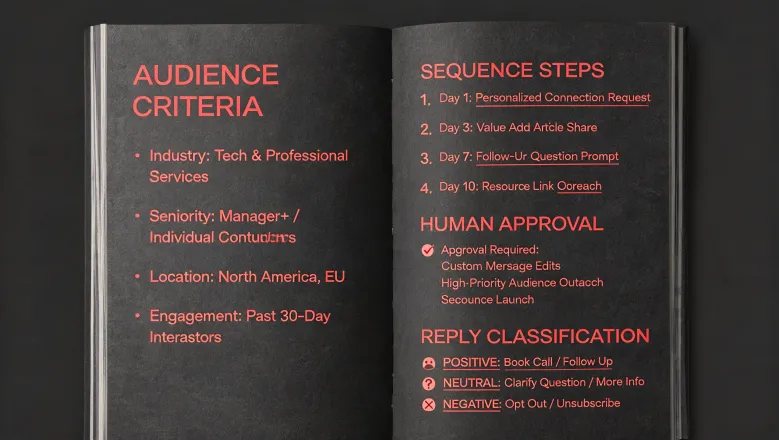
Last Tuesday at 3:47 PM, Sam from Sales dropped by my desk with his laptop open to a draft email sequence. "Can you approve this campaign? We need to send it tomorrow morning." He didn't look thrilled. The target was a 10-person startup called Brightpath. "Honestly," he said, "it's probably not worth much. But the founder signed up for our free trial, so I figured we'd throw a sequence at them."
I've been a quality and compliance manager at expandi for four and a half years. I review every outbound campaign before it reaches prospects—roughly 80 a month. In 2026, I've already rejected 14% of first drafts for missing compliance details or shaky claims. Sam's draft had both.
Sam has been with us for six months, and he's good. The kind of person who sends a follow-up before you've even replied to the first message. The problem is, "quick" sometimes edges out "qualified." That Tuesday, he was juggling three campaigns and a demo. His brain was already in the next meeting.
"Let me show you something," I said. I scrolled to the first email. The subject line promised "5x more replies." That's a fantasy, not a value prop. The body said "guaranteed LinkedIn outreach." We can't say that—we don't control LinkedIn. And there was no unsubscribe link. That's not just sloppy; it's a legal problem under FTC rules.
Sam shrugged. "For a 10-person startup? They won't sue us."
That's where we differ. I've seen a $22,000 redo and a delayed launch caused by exactly this "small risk" thinking. Quality issues don't discriminate by deal size.
A year earlier, we'd run two similar campaigns side by side—same offer, same audience size, but one list was verified and the other wasn't. The verified list had a 31% higher open rate and zero spam complaints. The unverified list landed three people in our spam folder and got one angry reply from an IT director who threatened to blacklist our domain. When I compared those results, I finally understood why verification isn't a nicety. It's the foundation.
"Cold outreach doesn't change just because we're using an agent-native prospecting workflow," I told Sam. "It changes how we execute, not why quality matters. The agent handles the repetitive stuff—finding contacts, enriching them, sending at scale. But the thinking, the messaging, the verification? That's still on us."
"But how does cold outreach fit into an agent-native workflow at all?" Sam asked. "If we're supposed to be hands-off, why are we reviewing this closely?"
Because automation amplifies whatever you feed it. Feed it a dirty contact list with unverified emails, and you'll send thousands of bounces, damage your sender reputation, and get flagged. Feed it a clean list with real intent signals, and the agent does what it's meant to do—deliver the right message to the right person at the right time.
What "Small" Actually Means
We opened up expandi, pulled the contact list, and ran it through the email checker. Nearly 15% of the addresses were invalid—a typical number for a scraped list. We also enriched the remaining records with company size, industry, and a recent tech-stack signal. One address belonged to "[email protected]," which looked fine until the email checker flagged it as a catch-all—a mailbox that accepts everything but never delivers. Without verification, we'd have sent six messages to someone who never would have opened them. That's how you burn a domain.
Then I showed Sam the beauty of expandi's pricing model. He was worried that adding all this functionality would blow up the campaign's cost. It didn't. expandi's pricing features are tiered so that even a small prospect like Brightpath can start without a huge minimum commitment. That's a small-friendly approach, and it matters when you're testing new verticals.
Brightpath had asked if we could push the enriched data to their own CRM via a webhook. I pulled up expandi's API documentation — which, unlike most vendors, is actually written for humans. With one endpoint and a JSON payload, the data flowed into their HubSpot pipeline automatically. That's a detail that sells itself.
We rebuilt Sam's sequence in about two hours. Here's where I'll admit something: I put a "P.S. We're a small team too." in the first email. It felt like a gamble. But it was also true, and it set the right tone for a small company.
Two hours before launch, Sam sent me a Slack message: "Are we sure about the P.S.?" I replied, "I'm never sure. But I've learned that being honest is the safest bet."
The next morning, I watched Sam hit "send" from across the room. He looked nervous. "Hit send, and immediately I thought, what if we still got it wrong?" he said later. "Didn't relax until the first replies came in."
The campaign pulled a 42% open rate and a 9% reply rate. One reply came from Marta, the founder. She wrote:
"I appreciate that you actually took the time to personalize this. Most automation we've seen is lazy."
That was the moment I knew we'd done the right thing. Not because of the numbers—I've seen better. But because a small prospect noticed the difference. And that's rare.
Brightpath didn't become a $50k customer overnight. They became an $89/month customer first. Marta upgraded to a higher plan two months later and referred two other startups our way. The total value of that "small" client, measured over a year, beat the average enterprise deal we closed in the same period.
What I Learned
So what did I learn from this? Three things.
Small doesn't mean unimportant. It means potential. The vendors who treated my $200 orders seriously when I was starting out are the ones I still use for $20,000 orders. The same logic applies to prospects.
Quality is a habit, not a stage. If you skip it for small deals, you'll eventually skip it for big ones. It's not about being strict. It's about being consistent.
Agent-native workflows are only as good as what you put in them. They can handle the volume; they can't handle the judgment. That part is still on us.
Also, the legal stuff isn't optional. Per FTC guidelines (ftc.gov), claims must be truthful and substantiated. The moment we put a number in a subject line, we become responsible for that number. That's not bureaucracy. It's survival.
I've reviewed more than 1,500 campaigns in four years. Around a quarter have the same problem Sam had: good intent, poor execution. The fix isn't more automation. It's more attention.
So if a small prospect ever lands in your pipeline, don't treat them like a waste of time. Treat them like a test of your entire operation. Because that's exactly what they are.

Julian Hartwell
Julian Hartwell is an independent B2B sales intelligence analyst covering contact databases, company data, decision-maker profiles, direct dials, prospect lists, and buying signals. He applies the ISO/IEC 25012 data-quality model while examining field accuracy, coverage, freshness, duplicate rate, match confidence, and source transparency. His evidence-led guides help revenue teams compare prospecting platforms, define acceptable data thresholds, and build account lists that support reliable territory planning and outreach.