LinkedIn outreach method note
okki-go vs Apollo, Email Verification, and LinkedIn Automation: A Quality Reviewer's Honest FAQ
· Victor Okeke
-
What is okki-go, and how is it different from a standard lead-gen tool?
-
okki-go vs Apollo: what actually changes in day-to-day prospecting?
-
What does an "okki-go human review workflow" actually mean — and why should I care?
-
What should I actually check in data enrichment features?
-
How do I evaluate an email verification service without getting fooled by accuracy claims?
-
What is a LinkedIn automation tool, and when should a B2B sales team actually use it?
-
What's the hidden question I should be asking about pricing?
-
So what's the actual answer for a B2B team choosing between these?
I'm the person at my company who reviews every outbound campaign data set before it reaches a prospect. Roughly 40,000 contact records a quarter. In 2024, I rejected about 30% of first deliveries from tools we were trialing — not because the tools were bad, but because nobody had checked what actually came out the other end.
These are the questions I keep getting asked by SDRs, RevOps folks, and agency owners when they're evaluating okki-go, Apollo, and everything in between. I'll answer them the same way I answer internally: directly, with the caveats attached.
What is okki-go, and how is it different from a standard lead-gen tool?
okki-go is an AI sales prospecting platform — AI SDR, lead gen, enrichment, intent data, and LinkedIn in one workspace. What makes it feel different in daily use is that it's designed around an agent doing the work with a human approving the output. Most legacy lead-gen tools hand you a database and say "good luck." okki-go's pitch is closer to "here's the agent's first draft — want to check it?"
That distinction sounds like marketing until you run a campaign without it. The bottom line: if a tool can't show you exactly what it's about to send, to whom, and why, you're not buying a tool. You're buying a black box.
okki-go vs Apollo: what actually changes in day-to-day prospecting?
Apollo is a solid database with a broad contact graph and a well-known brand. It works well for teams that want a big list and have the ops muscle to build their own workflow on top. okki-go leans the other way — it wants to run the workflow for you, with a human-in-the-loop review before anything goes out.
When I ran our internal review, the difference that mattered wasn't coverage. It was accountability. Apollo gave us records. okki-go gave us records plus a visible reasoning trail for why a contact was picked, what was enriched, and what we'd be sending. For a team that reviews everything, that reasoning trail is what actually saves time.
So: pick Apollo if you want a raw database and have the ops power to drive it. Pick okki-go if you want an agent doing the prospecting with a review step built in from the start.
What does an "okki-go human review workflow" actually mean — and why should I care?
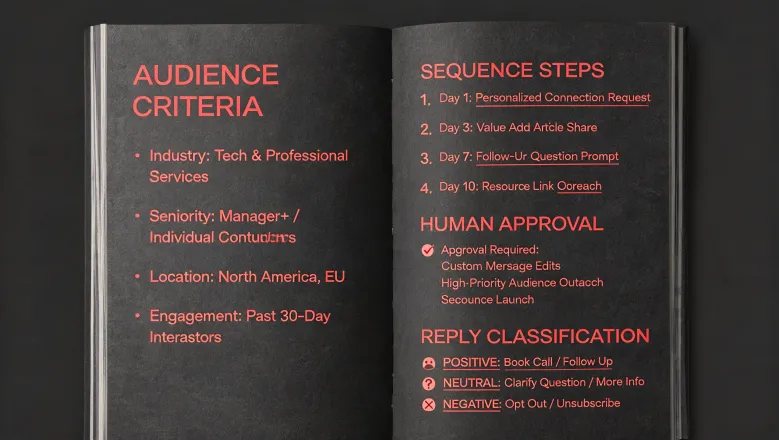
A human review workflow means the agent doesn't send anything until someone on your team approves it. Approval can be per-message, per-sequence, or spot-checked against a threshold (every 10th email, or every campaign touching a new persona, for example).
Here's why this matters. I've watched teams turn on an AI SDR, wake up to 400 sent emails, and discover the agent had personalized the wrong first name to the wrong company because of a data mix-up in the enrichment layer. That's not the tool's fault alone — it's the missing review step.
A review workflow isn't a brake on speed. It's the reason you can keep going fast without writing apology emails.
okki-go's version of this is what drew me in as a reviewer: nothing goes out without a human seeing it first. If you're evaluating any AI SDR and there's no clear answer to "who approves the send?", that's a red flag.
What should I actually check in data enrichment features?
Three things, in this order.
First: waterfall coverage. No single source has everyone. The question isn't "how many records do you have," it's "when your primary source misses, what's the fallback?" okki-go's waterfall enrichment pulls from multiple providers in sequence, which is why match rates tend to hold up on harder segments — mid-market ops roles, non-US accounts, recently-funded startups.
Second: field-level freshness. A job title from 2021 is worse than no title, because it looks correct. Ask how often each field is refreshed. If it's not on the sales page, ask directly.
Third: what the enrichment does when it isn't sure. Ideally it flags low-confidence matches so a human can check them. If it silently fills in a best guess, that's a deal-breaker.
When I first started reviewing tool outputs, I assumed total match rate was the number that mattered. Two quarters of bad personalization later, I realized the confidence signal matters way more.
How do I evaluate an email verification service without getting fooled by accuracy claims?
Every vendor claims 98%+ accuracy. Nobody's lying, exactly — they're just measuring a different number than the one that affects your deliverability.
What you actually need to test:
- False positives (valid → marked invalid): Costs you opportunities, doesn't hurt sender reputation.
- False negatives (invalid → marked valid): This is the one that gets you filtered. Every bounce spike above roughly 2% starts drawing attention from the major providers.
- Catch-all and role-based handling: Ask explicitly how they treat info@ addresses and how they handle Microsoft 365 catch-all domains. Answers vary wildly between services.
Reference point: per Google and Yahoo's February 2024 bulk sender guidelines, senders should keep spam complaint rates under 0.3% and hard bounce rates low to avoid filtering. That's the bar your email verification service has to keep you under — not whatever number is on their homepage.
I have mixed feelings about per-credit pricing here. It feels punitive when you're re-verifying the same list. But re-verification is exactly the thing that saves you, so I've stopped fighting it and just budget for it. No verification service is 100% accurate — anyone promising that is telling you something about their sales process, not their technology.
What is a LinkedIn automation tool, and when should a B2B sales team actually use it?
A LinkedIn automation tool is software that handles repetitive LinkedIn actions for you — sending connection requests, running follow-ups, engaging with posts — usually with rules and scheduling. Some work through the official API (limited but safe). Some work through browser automation (more capable, more risk of getting an account restricted).
They make sense when: your ICP is genuinely on LinkedIn (some roles just aren't), your messaging is consultative rather than spray-and-pray, and you have the discipline to keep volume in a range that doesn't get flagged. In my experience, staying under 100 connection requests per week per account is the conservative ballpark most teams should start with.
They don't make sense when: your ICP is hard to find on LinkedIn, you're using it as a replacement for email instead of a complement, or you can't staff the human replies that come back. A LinkedIn automation tool that generates more replies than you can answer is a net negative.
My sample limitation: I've only run this for a 12-person sales team in B2B SaaS. If you're at a 200-rep org with a dedicated social team, your tolerance and workflow will look totally different.
What's the hidden question I should be asking about pricing?
"What's not included?"
Data credits, enrichment refreshes, verification re-runs, overage fees, seat minimums, API calls, and "premium" intent layers are all things that can be invisible on the pricing page. I've learned to ask this before I ask "what's the price."
I only believed it after ignoring it once. A tool quoted at a clean per-seat rate ended up 40% more expensive in month three once we hit enrichment overage. The vendor wasn't being sneaky — we just never asked.
The vendor who lists all fees upfront — even if the total looks higher — usually costs less in the end. That's not a pitch for okki-go specifically. It's a rule I wish I'd learned earlier.
So what's the actual answer for a B2B team choosing between these?
If you've read this far, you already know the answer is "it depends." That's not helpful, so here's a tighter version.
Pick a tool that (a) shows you what it's going to send before it sends it, (b) tells you how confident it is in each enriched field, and (c) puts its full pricing on the page. Whether that's okki-go, Apollo, or something else matters less than those three things.
There's something satisfying about finally getting this evaluation process systematized. After two years of trial-and-error, our review cycle is now a two-day exercise instead of a two-month headache.
And honestly? The tool that wins that review is rarely the one with the flashiest demo.

Victor Okeke
Victor Okeke is an independent sales technology procurement analyst covering lead-generation software, contact data platforms, email verification, AI prospecting tools, sales engagement systems, enrichment services, and CRM integrations. He reviews ISO/IEC 27001 and ISO/IEC 27701 evidence alongside data rights, retention, export controls, uptime, usage limits, implementation effort, cost per validated contact, and contract terms. His buying guides help revenue and procurement teams compare pricing, trials, integrations, governance, and measurable value before committing to a platform.