LinkedIn outreach method note
Expandi Campaign Builder & LinkedIn Automation: Features, Pricing, and FAQ for B2B Sales Teams
· Julian Hartwell
-
What is Expandi?
-
What does the campaign builder actually do?
-
How much does Expandi cost?
-
How does the AI email writer work?
-
What should I read in the email verification API docs?
-
What is a LinkedIn connection and when should a B2B sales team use it?
-
Is LinkedIn automation risky?
-
What should I check before buying Expandi?
I'm the office administrator for a 140-person B2B company. I manage software procurement—roughly $300k a year across 12 vendors—and I report to operations and finance. I don't run LinkedIn outreach myself, but I'm the one who has to make sure the sales team actually uses the tools we pay for.
When we evaluated Expandi for LinkedIn automation, I had a list of practical questions. These are the ones that kept coming up:
- What is Expandi?
- What does the campaign builder actually do?
- How much does Expandi cost?
- How does the AI email writer work?
- What should I read in the email verification API docs?
- What is a LinkedIn connection and when should a B2B sales team use it?
- Is LinkedIn automation risky?
- What should I check before buying?
If you're comparing sales tools, these are the things I'd want to know before signing. You can jump to the question that matters most.
What is Expandi?
Expandi is a LinkedIn automation and B2B prospecting platform. It combines LinkedIn sequence automation, email finder and verification, data enrichment, and AI-assisted email drafting. It also integrates with tools like HubSpot and Zapier and has a REST API for custom workflows.
When I first started buying sales tools, I assumed the one with the longest feature list was the best. After several renewal cycles, I realized the opposite: the tool that fits the workflow wins. Expandi stood out because it covers the full prospecting flow—from first touch on LinkedIn to verified email follow-up—in one place.
To be fair, a lot of tools do pieces of this. The difference, from where I sit, is that Expandi treats each rep's outreach as an agent-native workflow instead of a shared inbox. That's a useful distinction when you're scaling outbound teams.
What does the campaign builder actually do?
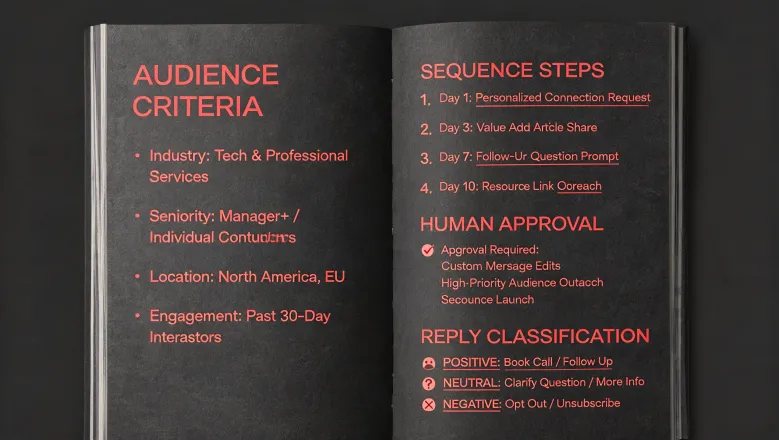
The campaign builder is a visual workflow where you define steps: send a connection request, wait two days, send a follow-up email, add a tag, trigger a webhook, or move the person to another sequence. You can set stop rules—if someone replies, cancel all actions. If they click a link, mark them as engaged.
That might sound obvious, but in practice it's the difference between a tool that sends messages and a tool that manages a conversation. You can build separate campaigns for separate segments instead of one big blast. Simple.
As a buyer, I like this because it makes the team stop and think before they launch. Preparing the workflow is the check. The launch is the result.
How much does Expandi cost?
Pricing was a little opaque when I checked the site on May 15, 2026. There's a trial, and paid plans are based on seats and email verification credits. I won't quote a number here because pricing pages change, and I do not want you to make a decision on stale data.
The more important thing is to ask how overages work. How many verified email addresses are included? What happens when you hit the limit? That's where the budget gets eaten—not in the base subscription.
I learned this the hard way with a different tool. I still kick myself for not checking the usage limits before signing. If I'd read the API docs first, I would have negotiated a different plan.
How does the AI email writer work?
The AI email writer drafts outreach messages based on a prospect's LinkedIn profile, company details, or intent signals. It's useful for generating personalized opening lines at scale. It can also create follow-up variations so the sequence doesn't feel canned.
Here's the prevention part: AI writes fast, but it also writes confidently. You need a manual review step before the first send. One wrong company name or a pain point that doesn't match is worse than no personalization. The checklist is the cheapest insurance you'll buy.
Granted, this adds time to the setup. But five minutes of verification beats five days of correction.
What should I read in the email verification API docs?
If you're planning to verify email addresses programmatically, read the API docs before you sign, not after. Look for single and batch verification endpoints, rate limits, webhooks, and what each status means—valid, invalid, risky, unknown, disposable.
When I checked on May 15, 2026, Expandi's public API docs covered single and batch verification, rate limits, and error codes. Useful if you have a developer on staff or you're building an internal workflow. But the doc doesn't matter if you don't have enough verification credits for the actual list. That's the operationally painful limit.
We didn't have a formal review process for renewal limits back then. It cost us a month of back-and-forth and an ugly overage invoice. Now I check volume first.
What is a LinkedIn connection and when should a B2B sales team use it?
A LinkedIn connection is a two-way relationship between profiles. You send an invitation, the other person accepts, and now you can see each other's posts and send direct messages. It's a relationship, not a lead list.
Use a connection when the prospect fits your ideal customer profile and you have a reason to start a conversation. Maybe they commented on something relevant, they have a role that commonly faces your problem, or a mutual connection introduced you. Send a personalized note. After they accept, follow up quickly.
Don't use connection requests to harvest emails or connect with people who have no reason to know you. That's spam, and it usually ends with restrictions. The question isn't just whether you can connect; it's what happens after they accept. If you don't have a good answer, don't send the request.
Is LinkedIn automation risky?
I'll be direct: no third-party tool can guarantee your LinkedIn account will never get restricted. LinkedIn's terms restrict scraping and aggressive automation, and LinkedIn enforces its rules in ways that can feel inconsistent. Any vendor who promises 100% safety is overselling.
What Expandi can do is give you controls that reduce risk: connection request limits, delays, stop rules, rotation between workflows, and manual review steps. Those help. But they're controls, not guarantees. A tool can't replace your judgment about whether a campaign is too aggressive.
My rule after years of buying software: prevent the problem before it starts. Set the safety limits, review the first campaign, verify the emails, and don't scale until the data looks clean.
What should I check before buying Expandi?
Before I sign a renewal, I run through a short checklist. It took me an embarrassing overage invoice to learn this, but now it's non-negotiable:
- Confirm the campaign builder supports the steps your team actually uses.
- Read the email verification API docs before you commit to a volume plan.
- Calculate total credits for a quarter, not a month.
- Ask how overage pricing works and what the cap is.
- Assign someone to review campaigns before launch.
- Run a trial on a small, segmented list—not the entire database.
The best sales automation tool isn't the one with the most features. It's the one your sales team will actually use without breaking your workflow. For us, Expandi made the shortlist because it covers the full prospecting stack. But I'd still test before scaling. Five minutes of verification beats five days of correction. Period.

Julian Hartwell
Julian Hartwell is an independent B2B sales intelligence analyst covering contact databases, company data, decision-maker profiles, direct dials, prospect lists, and buying signals. He applies the ISO/IEC 25012 data-quality model while examining field accuracy, coverage, freshness, duplicate rate, match confidence, and source transparency. His evidence-led guides help revenue teams compare prospecting platforms, define acceptable data thresholds, and build account lists that support reliable territory planning and outreach.