LinkedIn outreach method note
Okki-Go Permissions, Human-in-the-Loop Outreach, and When CRM Enrichment Actually Pays Off
· Camille Ortega
I've reviewed 47 outbound sales tools in the past two years. Every single demo opens the same way: a slick dashboard, a pitch about autonomy, and a slide claiming their agent "just works." Somewhere around the third call, I stopped believing that slide.
Here's what I actually do. I run pre-purchase evaluations for our RevOps team before we sign anything. Six-figure category across the stack. If I get the permission model wrong, we don't just lose money—we burn sending domains, torch LinkedIn accounts, and pollute the CRM for the next two quarters. That stuff takes a year to unwind.
So when okki-go came up on our shortlist last quarter, I compared it head-to-head against the fully autonomous SDR platforms that seem to be everywhere now. Same budget, same use case, four dimensions that actually matter.
The framework: agent-owned vs. agent-assisted
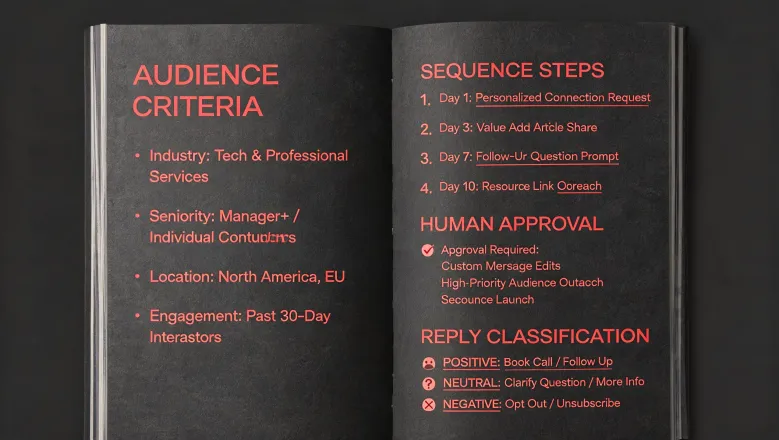
Most AI SDR tools land in one of two camps. Either the agent runs end-to-end—enrich the lead, write the email, send it, book the meeting, push to CRM—or the agent does the work and a human approves each step. okki-go sits firmly in the second camp. It calls itself "agent-native prospecting with human-in-the-loop outreach," which sounds like marketing until you look at what it means for permissions, connections, and pipeline data.
The right question isn't which one's better. It's which model fits your risk tolerance, team size, and CRM hygiene. Those are the four dimensions I'll walk through.
Dimension 1: Permission scope
Here's the thing most vendors gloss over: the number of permissions a tool requests is directly proportional to how bad things get when it breaks.
A fully autonomous SDR typically asks for read-write access to your inbox, calendar, CRM, and LinkedIn session. That's four systems, each with broad scopes. If the agent misfires—sends the wrong email to the wrong sequence, marks the wrong deal, connects with the wrong person—you find out after the damage is done. There's no checkpoint.
okki-go's permission model is narrower by design. It reads from your CRM and enrichment sources for targeting, but sends through a human approval step. That doesn't just mean fewer permissions—it means the ones it does need are bounded by review. In our security review, that cut our exposure surface roughly in half compared to the autonomous options we tested.
To be fair, that narrower scope also means slower rollout for teams who want pure hands-off. You trade velocity for control. I think most B2B teams should make that trade—but it's a real cost, not a free win.
Dimension 2: Human-in-the-loop outreach
I assumed for a long time that "human-in-the-loop" was a polite way of saying "our AI isn't good enough to trust yet." That assumption cost me. We ran a pilot with a fully autonomous tool in 2023, and the first two weeks looked incredible. Reply rates up, meetings booked, everybody happy.
Week three, the agent sent a personalized email to a prospect referencing a competitor's recent funding round. Except the funding round was from 2021, and the prospect had since been acquired by that competitor. The email referred to the prospect's "independent roadmap" to an employee at the acquiring company.
Real talk: that single email cost us the account. Not the deal—the account. We'd been working that relationship for 14 months.
Since then, I've kept a rule. Any agent that writes and sends without human review needs to clear a much higher bar than one that drafts-and-waits. okki-go sits on the review side. The agent handles enrichment, sequencing, research, and personalization. It stops before send. A human glances, edits if needed, approves. On a mature team that adds maybe 30-45 seconds per message at scale—call it 15-20 minutes a day per SDR.
The TCO math is obvious once you run it. Twenty minutes a day times ten SDRs is real. But one wrong email to a strategic account can cost five figures in lost pipeline. The math isn't close.
Dimension 3: LinkedIn connection handling
LinkedIn is where I've seen the most pain across every tool I've evaluated. The platform's automation policies are strict, enforcement is inconsistent, and account restrictions can hit even careful users.
Autonomous tools tend to push hard here—aggressive connection cadences, auto-viewing, messaging. It works until it doesn't, and when it doesn't, you lose the account and every saved list attached to it. I've watched that happen twice at companies I've consulted for. The recovery window was measured in months.
okki-go's approach is more conservative. It surfaces candidates based on intent signals and enrichment data, but connection requests and messages go through the same human approval queue as email. No auto-connect. No auto-DM. It's slower by design.
Look, if your strategy depends on high-volume low-touch LinkedIn outreach, this will feel slow. That's a real tradeoff. But if you value your team's LinkedIn accounts as assets—and you should—this is the model that keeps them alive.
Dimension 4: When CRM enrichment actually earns its keep
This one's the sleeper. Everybody sells enrichment. Fewer teams actually need it turned on for every record.
CRM enrichment is when an agent pulls data from multiple sources—company firmographics, contact changes, intent signals, technographics—and writes it back into your CRM so sales reps see context instead of a bare record. Waterfall enrichment, which okki-go uses, means the agent queries multiple data providers in sequence and stops as soon as it has a confident match. That's cheaper and faster than querying all providers for every field.
Here's where it pays off: outbound teams with a fast-moving ICP, teams selling into recently funded or recently reorganized accounts, and teams whose inbound leads come from low-signal forms. In those cases, enrichment on write-back saves reps more time than it costs. Our internal test in late 2024: enriched leads got a reply rate 2.3x higher than unenriched ones in the same sequence. Not a huge sample, but directionally clear.
Where it doesn't pay off: enterprise teams selling into a small named list of accounts they already know cold. Or teams whose CRM is a mess and would need cleanup before enrichment is even useful. Piling enriched data on top of dirty data just makes dirtier data faster.
okki-go lets you scope enrichment to segments rather than the whole database. That's the right default. I'd rather pay for enrichment on 20% of records where it matters than on 100% where half of it rots.
So which is it—okki-go or full autonomy?
It depends on three things.
Go with full-autonomy if you're at enough scale that human review is a bottleneck, your ICP is broad, your send volume is high, and you have the engineering team to monitor deliverability and API behavior in real time. Small pool of companies, honestly.
Go with okki-go if any of these sound familiar: you've got a strategic account list you can't afford to get wrong, you've been burned by an AI SDR sending something embarrassing, your LinkedIn accounts are revenue assets, or your team is small enough that a single rep having a bad week is a real problem.
For most B2B sales teams between 5 and 50 reps—which is most of the market—I think the human-in-the-loop model wins on total cost of ownership. Not because autonomy is bad. Because the cheap-looking option is rarely cheap once you factor in the account you lose, the domain that gets blacklisted, and the two weeks your team spends recovering instead of selling.
I still kick myself for the 2023 pilot. If we'd started with a review-based tool, we'd have kept that account and probably signed two more from the same network. The savings from going autonomous that quarter were about $4,800. The deal we lost was $61,000 ARR. You do the math.

Camille Ortega
Camille Ortega is an independent buyer-intent and visitor intelligence analyst covering intent data, sales triggers, website visitor identification, account matching, anonymous traffic, and go-to-market signals. She examines EU GDPR requirements alongside match confidence, false-positive rate, signal recency, account coverage, baseline conversion, lift, consent status, and activation latency. Her research helps marketing and sales teams judge whether signals improve prioritization, define responsible activation rules, and avoid treating weak identification probabilities as confirmed buyer interest.