LinkedIn outreach method note
Expandi LinkedIn Automation Features 2025: What RevOps Should Evaluate in a Professional Email Finder
· Julian Hartwell
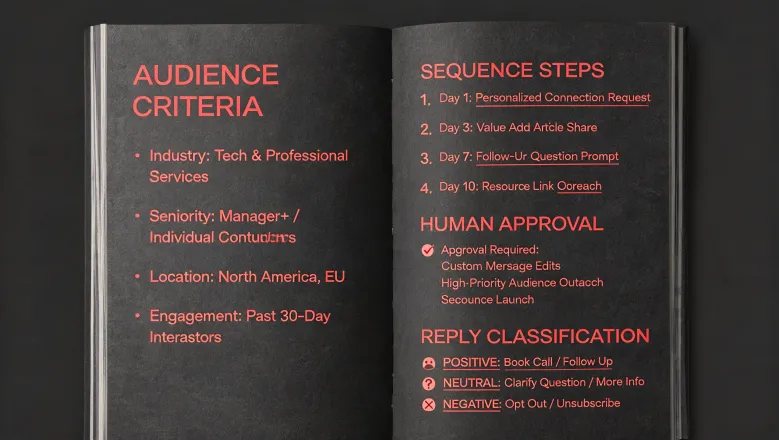
I'm the quality and brand compliance manager at an AI sales prospecting company. I review every campaign asset and tool output before it reaches customers—roughly 200 unique items a year. In 2025, I've rejected around 12% of first deliveries because they didn't meet spec. So when a revenue operations team asks me what to look for in a professional email finder, I give them a checklist, not a feature list.
This checklist is for RevOps teams building LinkedIn lead generation workflows, especially if you're considering the Expandi tool or pairing LinkedIn automation with an email finder and a power dialer. Here are seven checks I'd run, in the order that matters.
What Should Revenue Operations Teams Evaluate in a Professional Email Finder?
1. Define what "good" means before you log in
Most teams start by comparing dashboards. I start by writing the spec. What does a "good" email record look like? Is it any address, or only a direct mailbox? Is a role-based address acceptable? Do you need a source URL, a verification status, and a timestamp? What confidence threshold should trigger an export?
When I review an email finder, I use the same question I use for every deliverable: if this output came from a vendor, would I accept it without checking? If the answer is no, the spec isn't complete.
If you don't define the spec before the demo, every tool looks good. That's not a tool problem; it's a requirements problem.
Checkpoint: write down three use cases for the data—LinkedIn lead generation, an email sequence, and a power dialer. Each one changes the output spec.
2. Ask what "verified" actually means
This is where I see the biggest gap between sales claims and quality. One tool's "verified" is another tool's "we sent a test email and it didn't bounce immediately." Those are not the same thing.
When I compared two email finders side by side—one with a transparent methodology page, one with a green "verified" badge—I finally understood why RevOps teams keep getting burned.
According to USPS Business Mail 101, a standard letter has maximum dimensions of 6.125 by 11.5 inches. Email verification has no equivalent public standard. So a "verified" label is only meaningful if the vendor defines it.
Per FTC business guidance (ftc.gov/business-guidance/advertising-marketing), claims have to be truthful, not misleading, and substantiated.
Ask: Does the tool use an SMTP handshake, a seed list, or a third-party provider? Does it detect catch-all domains? Does it separate "verified" from "risky" and "unknown"? Does it keep the verification metadata on the record, or does it just export a CSV with a boolean?
Checkpoint: if the only answer is "we verify with our own algorithm" and there's no public explanation, treat it as a risk.
3. Check data freshness, not just database size
Email data is time-bound. An address that was valid in Q1 can be dead by Q3. That's why I'd rather see a smaller list with fresh verification dates than a huge list with no dates at all.
Data enrichment is part of this too. When a record updates—job change, company change, new phone number—does the tool reflect it? Or does it replay a nine-month-old index? I don't have hard data on industry-wide decay rates, but based on our deliverability reviews, my sense is that stale records cause more damage than most teams realize.
If a LinkedIn automation sequence sends stale emails, the damage isn't just a bounce. It's the sender reputation that follows.
Checkpoint: look for a "last verified" field on an actual record. If it isn't there, the tool is selling a database, not data quality.
4. Don't evaluate the email finder in isolation
LinkedIn lead generation rarely works as a single channel. Most RevOps stacks combine LinkedIn automation, email sequencing, and sometimes a power dialer. The email finder is the data layer under all of it.
When I evaluate the Expandi tool, I look at how the email finder connects to the rest of the prospecting stack. Does it pass verification metadata into the CRM? Does it suppress already-contacted records? Does it feed enrichment back into the sequence? Or is it a standalone export that requires a human to stitch things together?
Expandi LinkedIn automation features 2025 make more sense when you view them as part of an agent-native workflow. The agent handles the back-and-forth: enriching a lead, finding the email, checking the source, then moving it into outreach. That only works if the email finder is designed to share context, not just output rows.
The email finder should be a module in an operating system, not a separate website you visit after every export.
Checkpoint: trace the path from lead discovery to verified email to outreach sequence. If any handoff requires a CSV upload, you've found the weak point.
5. Beware the catch-all verification trap
This is the step most teams skip. A catch-all domain accepts email to any address on that domain, so a simple SMTP check will call almost anything "verified." In reality, many of those addresses go to a shared inbox or a mailbox nobody reads.
I don't have hard data on industry-wide catch-all bounce rates, but based on our Q1 2024 quality audit, my sense is that treating catch-all as "verified" is one of the largest hidden causes of low reply rates and sender reputation damage.
That pattern usually shows up as "data quality issues" in post-campaign reviews. What I mean is the addresses looked valid in the CRM, but the conversations never happened.
At least, that's been my experience with B2B outreach. If you're targeting consumers or very small businesses, the proportion of catch-all domains will be different.
Checkpoint: ask the vendor how they classify catch-all domains. Do they flag them, block them, or quietly call them verified?
6. Run a blind test on your own data
Vendor checklists are designed to make the vendor look good. Your checklist should be designed to make the output useful. So run a blind test.
I ran a blind test with our RevOps team: same 200 lead list, two email finder tools. One returned more matches but lower precision. The other returned fewer records, but each one had a source, a verification method, and a last-verified date. About 78% of the team picked the second tool as "more professional" without knowing which tool was which.
That doesn't mean more data is bad. What I mean is that the definition of "good" should be set by your workflow, not by a vendor's marketing page.
If a vendor objects to a blind test, that's telling.
Checkpoint: evaluate with the same seed list, then actually send a small test sequence. Match rate matters, but reply rate and bounce rate matter more.
7. Review the pricing page like an audit
I've learned to ask "what's NOT included" before "what's the price." That applies to email finders too.
Does the plan include credits for invalid emails, or do you pay for "verified" records that bounce later? What counts as a verified email? Is there a separate fee for API access, data enrichment, or integrations? Looking back, I should have asked about credit definitions in our first email finder contract. At the time, I assumed "verified" meant "deliverable." It didn't. That mistake cost us a quarter of wasted outreach and a full SDR workflow redo.
Transparent pricing is a quality signal. The vendor that lists all fees upfront—even if the total looks higher—usually costs less in the end. That is an area where I do not compromise.
Advertising claims should match contract terms. If the marketing page says "verified" and the invoice counts invalid emails, the mismatch is a quality defect.
Checkpoint: calculate total cost for a 10,000-contact quarter, including overage, API, enrichment, and exports. If the vendor can't answer in one call, that's a finding.
Common mistakes to avoid
- Choosing a tool on match rate before asking about precision and verification method.
- Assuming "verified" is a universal standard instead of a vendor-specific claim.
- Testing with the vendor's sample data instead of your own.
- Ignoring how the finder integrates with LinkedIn automation and a power dialer.
- Not asking what happens when a verified email bounces.
My experience is based on reviewing roughly 200 outreach deliverables and tool integrations a year for B2B teams. If you're a solo founder building a one-off list, you can skip some of these steps. And if your niche is enterprise accounts with purchased intent data, your priorities will shift.
The best professional email finder isn't the one with the largest database. It's the one that can prove how it verifies, keeps data fresh, and passes that context into your outreach workflow. Use the checklist, run the test, and make the vendor show their work.

Julian Hartwell
Julian Hartwell is an independent B2B sales intelligence analyst covering contact databases, company data, decision-maker profiles, direct dials, prospect lists, and buying signals. He applies the ISO/IEC 25012 data-quality model while examining field accuracy, coverage, freshness, duplicate rate, match confidence, and source transparency. His evidence-led guides help revenue teams compare prospecting platforms, define acceptable data thresholds, and build account lists that support reliable territory planning and outreach.