LinkedIn outreach method note
Expandi Pricing 2026: A 6-Step Checklist for Evaluating LinkedIn Automation Features in a Free Trial
· Julian Hartwell
-
Step 1: Map total cost of ownership, not the monthly price
-
Step 2: Map Expandi's LinkedIn automation features to your actual sequence
-
Step 3: Run a 50-record B2B enrichment and verification test
-
Step 4: Evaluate cold email platform features by deliverability, not templates
-
Step 5: Test integrations, API limits, and agent-native workflow triggers
-
Step 6: Price certainty into the decision: support SLAs and exit terms
-
Common ways a free trial gets expensive
I'm a procurement manager at a 95-person B2B SaaS company. I've managed our sales tech stack budget ($85,000 annually) for four years, negotiated with 30+ vendors, and documented every order in our cost tracking system. When revenue operations opens a free trial without a plan, I start a spreadsheet. This checklist is that spreadsheet.
If your team is asking what should revenue operations teams evaluate in free trial LinkedIn automation, start with the six steps below. They work for Expandi pricing 2026, and they work for any B2B prospecting stack.
Step 1: Map total cost of ownership, not the monthly price
From the outside, a free trial looks like the cheapest possible option. The reality is that a trial costs your team's time, your data quality, and your future negotiation leverage. When I looked at Expandi pricing 2026, I didn't start with the headline. I built a TCO list:
- Setup and integration time (including who actually does the setup)
- Data credits or overage fees for enrichment and email verification
- Training time for SDRs and operations staff
- Data cleanup if trial records land in your production CRM
- Migration cost if you leave an existing prospecting tool
I'm not 100% sure Expandi's exact 2026 rate card is stable, because usage-based pricing rarely is. That's the point: the number on the pricing page is not the total cost. The total cost is the number after you multiply hours by loaded hourly rate, add data overages, and add a margin for the unexpected.
Checkpoint: You can explain each of the five items above for your company in one sentence.
Step 2: Map Expandi's LinkedIn automation features to your actual sequence
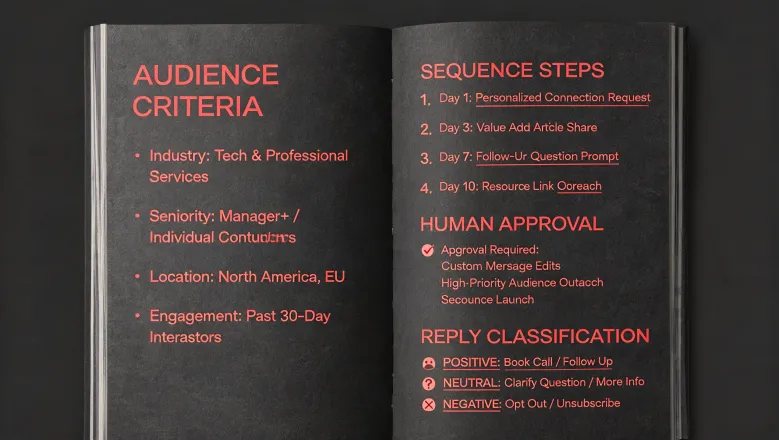
Don't ask, "Does it do LinkedIn automation?" Ask, "Does it automate the sequence we actually run?" Expandi LinkedIn automation features are useful only if they map to your playbook. During the trial, test the following:
- Invitation with a personal note and follow-up sequence logic
- Exclusion lists (existing connections, current customers, competitors)
- Delay randomization and daily sending limits
- Approval workflow for message copy
Agent-native workflows are easy to miss in a feature review. The test is not "can it send messages." It's "can an agent or CRM trigger a message without a human copying a CSV." (Think: your AI SDR flags a buy signal, an API call creates a prospect, then the workflow sends a LinkedIn invite.) If that path matters to you, test it before you sign.
Checkpoint: Map your top three playbooks to features in the trial. If one playbook has no feature, mark it as "not covered" before you get attached to the UI.
Step 3: Run a 50-record B2B enrichment and verification test
B2B enrichment is a hidden-cost zone. A tool might show clean dashboards and still write bad data into your CRM. Instead of testing 100,000 records, test 50 records you can verify manually: 10 current customers, 10 lost opportunities, 10 target titles, 10 recent job changers, and 10 companies with unusual domains.
The surprise wasn't the price difference in my test. It was the data quality difference. One vendor's enrichment records had source links; the other's did not. That difference showed up again when we looked at bounced emails and replied-to emails. The cheaper data would have cost more in email reputation damage.
Per FTC Business Guidance on Advertising (ftc.gov), claims must be truthful and substantiated. That principle applies to your cold emails too. If your sequence says "I noticed you moved to..." that's a claim. You need enough evidence to defend it.
Checkpoint: You can tell which enrichment fields have source links and which are inferred. If you can't, don't put those fields in outreach copy.
Step 4: Evaluate cold email platform features by deliverability, not templates
Cold email platform features should be judged by what protects sender reputation, not by drag-and-drop editors. In your trial, look for:
- Custom tracking domain setup
- SPF, DKIM, and DMARC configuration instructions
- Suppression list sync with your CRM
- Sending limits and ramp-up controls per inbox
- Reply routing and conversation history in one place
Send a test to your own Gmail, Outlook, and work address. A platform with strong cold email features will have a deliverability setup you can read without opening a support ticket. If you can't tell whether you share a sending domain with other customers, flag it.
Checkpoint: You know your daily sending limit per inbox, and you have tested delivery to at least three different email providers.
Step 5: Test integrations, API limits, and agent-native workflow triggers
Expandi's full prospecting stack includes LinkedIn automation, email finder and verification, B2B enrichment, and integrations. The trial is the time to test connectors such as Zapier, HubSpot, or webhooks. Don't save that for implementation week.
Ask for the rate limits on enrichment and API calls. Ask whether a reply in LinkedIn or email triggers a webhook or CRM update. Ask whether an AI SDR agent can call the API to start a sequence. (This is the 2026 integration pattern, and you want to know the limits before an agent-native workflow hits a wall at 2,000 records per day.)
Checkpoint: You can name one API trigger, one API action, and the rate limit numbers that apply to your peak usage.
Step 6: Price certainty into the decision: support SLAs and exit terms
This is the step most revenue ops teams ignore during a free trial. Support response time is a cost line item, not a nice-to-have. If your outbound campaign is tied to a conference, a product launch, or a quarterly target, a 24-hour support gap is a missed deadline.
I went back and forth between a lower-priced platform and Expandi for two weeks. The lower-priced one had a better sandbox. Expandi had a 4-hour support response promise that matched our launch deadline. For normal campaigns, 24 hours is okay. For a launch sequence, 24 hours is a missed sequence (unfortunately, that's when support tickets pile up). I chose the higher annual rate because certainty was worth the difference.
To be fair, the lower-priced platform wasn't bad. It just didn't price certainty into its contract. Ask the vendor: what is the contractually committed response time? Is it business hours? What happens if you miss it? In an emergency, "best effort" is not a plan.
Also audit the exit: data export, suppression list transfer, and whether trial records are deleted or kept. So glad I asked about this before the trial ended; we almost left test data in the CRM and turned a free trial into a week of cleanup.
Checkpoint: You have written answers for support response time, data export, and renewal price increase before you connect production data.
Common ways a free trial gets expensive
- Connecting production CRM on day one. Use a sandbox or test lists. Cleaning merged contacts costs more than any trial discount.
- Counting features instead of tested workflows. A menu of 100 templates is worth less than one workflow that fits your sales playbook.
- Ignoring API limits. You only discover them after your agent-native workflow hits a wall.
- Paying for an annual plan before testing support. The discount only helps if the tool works when your deadline is on the line.
- Trusting "guaranteed responses" language. You're buying a workflow, not an outcome.
If you ask me, free trials are only free when you have a checklist. Expandi pricing 2026 will make more sense after you run the six steps: the real price is TCO, enrichment accuracy, deliverability, workflow fit, integration limits, and support certainty.

Julian Hartwell
Julian Hartwell is an independent B2B sales intelligence analyst covering contact databases, company data, decision-maker profiles, direct dials, prospect lists, and buying signals. He applies the ISO/IEC 25012 data-quality model while examining field accuracy, coverage, freshness, duplicate rate, match confidence, and source transparency. His evidence-led guides help revenue teams compare prospecting platforms, define acceptable data thresholds, and build account lists that support reliable territory planning and outreach.