LinkedIn outreach method note
Expandi vs Dripify? What Revenue Ops Should Actually Evaluate in a Prospecting Agent
· Julian Hartwell
Most revenue operations teams evaluate prospecting agents the wrong way. They compare feature lists, template counts, and price per seat. I think that's a mistake, and it's an expensive one. A better evaluation starts with the same mindset a quality manager brings to a production line: define the tolerance, inspect the failure modes, then approve the batch.
I'm a quality/compliance manager in B2B sales technology. I review roughly 350 workflows, data pipelines, and campaign templates every year. In 2025, I rejected 14% of first submissions for consistency issues: wrong variables in email sequences, missing data consent flags, and enrichment records that looked correct but weren't. It took me three years and more than one failed launch to understand something that now seems obvious. Quality problems are almost never feature gaps. They are process gaps.
The feature list is not a quality spec
A tool can have every feature on your spreadsheet and still fail in production. A demo shows a clean email sequence, a perfect data enrichment API response, and a LinkedIn automation workflow that connects with the right people. Your operation is not a demo. It runs at volume, with dirty data, imperfect names, and edge cases.
So when I evaluate a prospecting agent, I do not ask 'does it do X?' I ask 'what does it do when X goes wrong?' That is the difference between a feature and a quality attribute.
What should revenue operations teams evaluate in a prospecting agent?
Here's what I've landed on after years of reviewing deliverables. And I'll be honest: I only believed some of this after ignoring it and paying the price. Three checks matter most.
1. The email sequence should fail safely
An email sequence is not a series of emails. It's a stateful workflow: recipients, variables, timing, replies, suppression, and re-engagement all interact. The happy path is easy to test. The hard part is what happens when a variable is missing, a company field is empty, or a rep replies during a scheduled follow-up.
They warned me about variable merge failures. I didn't listen. It took one 1,200-email campaign with empty company names to change how I review email sequences.
That is why, in my opinion, revenue operations teams should evaluate email sequence controls as carefully as deliverability metrics. Per Google and Yahoo sender guidelines effective February 2024, bulk senders are expected to keep spam complaint rates below 0.3% and support one-click unsubscribe. If an email sequence can fail that threshold because of a merge error, it's not a small bug. It's a compliance defect.
2. The data enrichment API needs a tolerance, not just an endpoint
Almost every sales automation tool has a data enrichment API now. That statement is meaningless. The real question is what happens when the API is uncertain. '95% match rate' sounds strong, but on 10,000 records, 95% means 500 bad records. Those 500 records become 500 wasted dials, bounces, and bad first touches.
For revenue ops, the quality spec should include field-level confidence, handling of ambiguous records, and verification of emails before they enter an email sequence. When I review expandi's data enrichment API, I don't just check if the endpoint exists. I check whether it can suppress low-confidence records before they touch my sequence. That is a quality tolerance, not a feature.
3. Agentic LinkedIn automation needs guardrails
The phrase 'expandi linkedin automation features' comes up a lot in this category. I get why. LinkedIn automation is where a prospecting agent starts to feel like magic, and also where it can do the most damage.
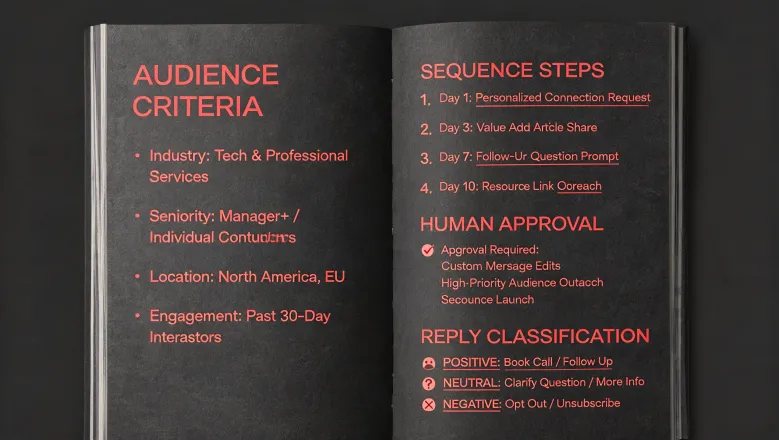
What matters to me as a quality manager is not how many actions the agent can perform. It's what the control layer looks like:
- Per-account limits and controlled pacing so activity doesn't resemble a bot.
- Suppression lists and exclusion rules before every action, not just at campaign start.
- Manual review points for connection requests and high-risk messages.
- Audit logs that explain why the agent made each decision.
LinkedIn's User Agreement restricts automated activity, and no tool—including expandi—can guarantee LinkedIn account safety. If a vendor implies otherwise, that is a red flag. But a good quality control layer gives your team visibility and control, which is the best any responsible tool can do.
A simple acceptance checklist for revenue ops
Here's the checklist I use when evaluating a prospecting agent. It is not a product demo checklist. It's an acceptance test.
- Define the failed batch. What counts as unacceptable? 0.5% bad emails? 2% invalid records? Write it down before the demo.
- Test with your own data. Use 200 real records with varied formatting, not the vendor's clean sample.
- Run a live email sequence to a small segment. Check merge fields, subject lines, and follow-up behavior.
- Test the enrichment API with ambiguous inputs. See if it returns confidence scores or guesses.
- Review the audit log after a simulated agent run. If you cannot tell why the agent acted, treat it as a defect.
This is the same way I approve a production batch: sample, inspect, reject if outside tolerance. It is not the fastest procurement process, but it is the cheapest one over time.
So where does the 'Expandi vs Dripify' question fit?
I hear 'expandi vs dripify' from sales ops teams. It makes sense. Both tools can connect with prospects on LinkedIn, run email sequences, and integrate with a CRM. But comparing them like products is the wrong frame. You are buying an operating process, not a static tool.
Dripify is a capable platform, and plenty of teams get solid results with it. This is not an attack on Dripify. My point is that the more important comparison is against your own specs. What is your tolerance for bad enrichment? Who reviews messages before they send? How do you prove deliverability after a campaign ends? If a tool can't answer those questions, its feature list does not matter.
To be fair, budgets are real. I get why teams choose a lower-priced option and tell themselves the extra cleanup work is manageable. But I've sat on the wrong side of that decision. Every spreadsheet said the cheaper enrichment was good enough. My gut said the high 'unknown' rate was going to produce a bad first touch. We shipped anyway. The campaign underperformed, and we spent more time cleaning data than selling. I don't ignore that tension anymore.
There's something satisfying about a campaign that launches without the pre-launch dread. Every variable resolved, every record verified, every suppression list in place. That feeling is not just confirmation bias. It's what quality looks like after you define it.
My take
Stop asking which tool has the most templates. Start asking what happens when the template breaks. Revenue operations teams should evaluate prospecting agents like quality managers: define tolerances, inspect failure modes, and then decide if a tool helps you stay inside those tolerances. I think expandi gets that. But the important part is to demand it from any tool you buy.

Julian Hartwell
Julian Hartwell is an independent B2B sales intelligence analyst covering contact databases, company data, decision-maker profiles, direct dials, prospect lists, and buying signals. He applies the ISO/IEC 25012 data-quality model while examining field accuracy, coverage, freshness, duplicate rate, match confidence, and source transparency. His evidence-led guides help revenue teams compare prospecting platforms, define acceptable data thresholds, and build account lists that support reliable territory planning and outreach.