LinkedIn outreach method note
How Does LinkedIn Automation Scraping Fit Into an Agent-Native Prospecting Workflow?
· Matteo Ferraro
-
How Does LinkedIn Automation Scraping Fit Into an Agent-Native Prospecting Workflow?
-
The Three Scenarios (And Why They Don't Share a Playbook)
-
Scenario A: LinkedIn Scraping as a Contact List Builder
-
Scenario B: LinkedIn Scraping as a Sequence Trigger
-
Scenario C: LinkedIn Scraping as a Signal Layer Only
-
How to Figure Out Which Scenario You're Actually In
How Does LinkedIn Automation Scraping Fit Into an Agent-Native Prospecting Workflow?
I'm a quality and brand compliance manager at a B2B SaaS company. I review every outbound sequence, contact list, and messaging template before it reaches a customer or prospect—roughly 300–400 artifacts a year. Since we tightened our outreach review protocol in 2023, I've rejected maybe 22% of first-draft sequences, and data-sourcing issues (bad emails, scraped lists without consent documentation, LinkedIn copy-paste errors) account for a big chunk of those rejections.
So when people ask me "how does LinkedIn automation scraping fit into an agent-native prospecting workflow," I can't give one answer. It depends entirely on what you're scraping for, who's doing the scraping, and what happens to that data downstream. Over the past two years I've seen three genuinely different patterns work—and each one treats LinkedIn scraping as a completely different kind of input.
Here's the framework I use when I audit an outbound stack.
The Three Scenarios (And Why They Don't Share a Playbook)
The conventional wisdom is that LinkedIn scraping is just "data acquisition" and everything downstream is the same. My experience with maybe 40 different outbound vendors and tools suggests otherwise. The same scraped profile data behaves differently depending on what layer of the workflow it feeds.
Roughly, teams fall into one of three buckets:
- Scenario A: Small SDR teams (1–5 people) using LinkedIn scraping as a contact list builder
- Scenario B: Outbound agencies and multi-client teams (5–25 seats) using LinkedIn scraping as a sequence trigger
- Scenario C: Enterprise RevOps and regulated industries using LinkedIn scraping as a signal layer only
Each one has a different compliance surface, a different quality bar, and a different answer to "should the agent act on this automatically?"
Scenario A: LinkedIn Scraping as a Contact List Builder
This is the classic use case. You scrape Sales Navigator results, run the profiles through an enrichment tool (this is where okkigo's waterfall enrichment and okkigo email verification come in), and push a clean list into your CRM.
What most people don't realize is that the scraping step here is actually the least risky part of the workflow if you're doing it right—and the most risky if you're doing it wrong. The list building pattern works when:
- You're scraping from a logged-in Sales Navigator account (not a bypass tool)
- You enrich immediately and verify emails before any sequence fires
- A human reviews the first 50–100 contacts before scaling
In this scenario, the agent-native part is really the enrichment and verification, not the scraping. The okkigo prospecting agent handles waterfall enrichment (pulling from multiple data sources in sequence until it finds a match) and intent signals, but the scraping itself stays simple.
The mistake I see most: teams scrape aggressively, then skip verification. That's how you end up with 30% bounce rates and a burned sending domain.
Scenario B: LinkedIn Scraping as a Sequence Trigger
This one is more interesting—and honestly, this is where I've changed my mind over the past 18 months.
Everything I'd read about LinkedIn automation said scraping should be kept separate from outreach execution. But in practice, for agencies running multi-client outbound, the scraping actually has to be tightly coupled to the sequence logic. Here's why: the agency's value proposition is "we noticed X about your LinkedIn activity, and here's a relevant message." If the scraping signal is stale by even 48 hours, the whole personalization falls apart.
The workflow that works here:
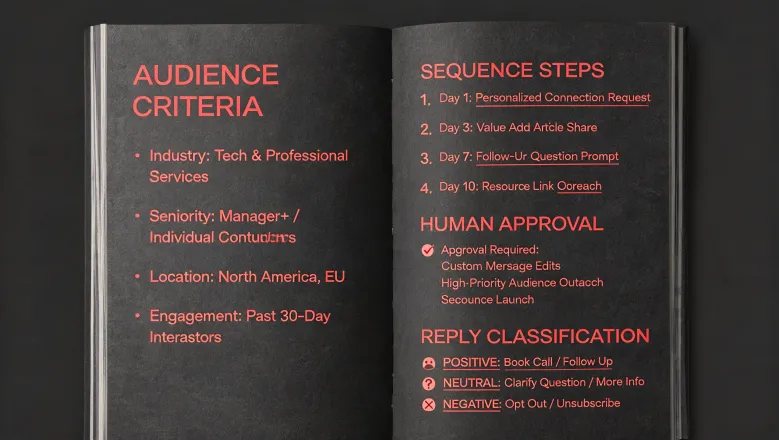
- LinkedIn Sales Navigator automation surfaces profiles matching an ICP filter (job change, hiring post, new product launch)
- The okkigo prospecting agent ingests that signal and scores it against the client's ideal customer profile
- Human-in-the-loop review happens for the first ~20 contacts per client per week
- Once approved, the agent queues the outreach, mixing LinkedIn touches with verified email
The tradeoff: this is faster and more personalized, but the compliance surface is bigger. You need documented consent for the emails, and you need to actually respect LinkedIn's rate limits on the scraping side. The "we'll just scrape harder" approach breaks at scale.
Scenario C: LinkedIn Scraping as a Signal Layer Only
This is the pattern I see in regulated industries (fintech, healthcare, anything touching financial data) and at companies above ~200 employees with an actual legal review process.
In this scenario, LinkedIn scraping never produces a contact record directly. It only produces signals—job changes, company growth indicators, posting activity—which then feed a scoring model. Contacts still come from opt-in sources, form fills, or verified purchased lists. The LinkedIn data just tells you when to reach out and what angle to use.
I'd argue this is the pattern most teams should aspire to, even if they can't get there yet. It's slower. It requires more infrastructure. But the compliance risk drops dramatically, and the reply quality goes up because you're not cold-pitching into the void.
From my quality-review seat, Scenario C produces the lowest rejection rate on first-draft sequences—under 8%, compared to 22% company-wide. The reason isn't better copywriting. It's better targeting.
How to Figure Out Which Scenario You're Actually In
Forget what you want to be doing. Look at three things:
1. Who touches the raw scraped data? If a human reviews every single contact before outreach, you're in Scenario A territory. If it flows into a template automatically, you're in B. If it never becomes a contact at all, you're in C.
2. What's your blast radius if something goes wrong? A small SDR team that accidentally sends bad emails to 500 people can recover. An agency doing it across 15 clients at once cannot. Regulated industries can't even try.
3. What does your legal team think? I'm not a lawyer, so I can't speak to GDPR or CCPA specifics—you need your own counsel for that. But what I can tell you from a compliance-review perspective is that the teams who loop in legal before building the scraping workflow end up with fewer rebuilds than the ones who ask for forgiveness later.
The conventional wisdom in 2020 was "scrape everything, filter later." That advice is mostly obsolete now. Not because scraping is bad—it isn't—but because the downstream tools (enrichment, verification, agent-native decisioning) are good enough that the bottleneck has moved. The question isn't can you scrape. It's what should happen next.
Get that second question right, and the scraping part becomes almost boring. Which, honestly, is exactly what you want from the data layer.

Matteo Ferraro
Matteo Ferraro is an independent sales engagement analyst covering sales sequences, cadences, multichannel outreach, power dialers, parallel dialers, task queues, and pipeline follow-up. He applies ISO/IEC 27001 access-control principles while measuring connect rate, reply rate, positive-response rate, meeting conversion, attempt density, queue latency, disposition accuracy, and unsubscribe completion. His workflow comparisons help outbound leaders choose engagement platforms, design fair performance baselines, and coordinate calls, email, and manual tasks without sacrificing governance or prospect experience.