LinkedIn outreach method note
Okki Go Human Review Workflow: What I Learned After My AI Email Sequence Backfired
· Julian Hartwell
-
Why I was searching for okki go alternatives without a workflow
-
The email sequence that went sideways
-
Lead generation software multiplies bad decisions too
-
Okki Go's human review workflow was the missing layer
-
How AI sales assistant features fit into an agent-native prospecting workflow
-
What I'd tell anyone comparing Okki Go alternatives
On a Tuesday morning in March 2024, our domain health score dropped. I didn't notice at first. A few extra unsubscribes, a couple of spam reports, IT flagged us later that afternoon. The email sequence we had launched overnight was supposed to be AI-powered. The only problem: no human reviewed any of it before it went out.
I manage revenue operations for a B2B SaaS company. For the past five years, I've handled outbound tooling and process design for small SDR teams. I've personally made (and documented) four significant mistakes, totaling roughly $28,000 in wasted budget and team hours. This was mistake number three. It wasn't the most expensive mistake, but it was the one that finally taught me how automation should work.
Why I was searching for okki go alternatives without a workflow
Earlier that year, I was evaluating lead generation software. My team had a CRM full of stale contacts and pressure to do more with the same headcount. I did what buyers do when they're in a hurry: I compared features before I understood the process.
I literally searched for 'okki go alternatives' and set up four demos. Every vendor showed me the same dashboard: connect your CRM, pick your persona, watch the AI build a list and write an email sequence. The phrase 'AI sales assistant' came up in every call. But no one asked the one question that should have mattered: what happens after the AI drafts the message?
I signed with a platform that made that step optional. Guess what I did. I skipped it.
The email sequence that went sideways
After we connected the CRM and imported 1,400 contacts, the AI assistant did its thing. It created a five-touch sequence, scheduled emails and LinkedIn actions, and synced replies to Salesforce. I reviewed the first two touches, then turned off the approval setting. The SDRs were overloaded. I told myself we needed speed.
We got speed. We also got emails that congratulated a VP on a promotion she received in 2021, referenced a funding round that was three years old, and repeated one random website fact in every single touch.
The contact list was worse. The platform's own verification step accepted bad addresses. We saw bounces, then complaints, then a blocklist warning. In one week, we went from a healthy domain to the kind of report that makes a CTO ask what you are doing.
That email sequence cost us more than the software subscription. It cost trust.
Lead generation software multiplies bad decisions too
I wanted to blame the vendor. But the product did exactly what I set it up to do. I asked for hands-off automation, and it gave me hands-off automation.
Here's the misconception that hurt me: people think lead generation software is about finding more contacts. That's only true if you have a system to verify and review those contacts. Without one, more data means more bounces. More bounces teach email providers to filter you. More automation makes all of it faster.
Email providers have also tightened the rules. Google and Yahoo's 2024 sender guidelines require bulk senders to authenticate with SPF, DKIM, and DMARC and keep complaint rates low. If you send unverified contacts through an automated sequence, the deliverability cost shows up fast. (Source: Google and Yahoo sender guidelines, 2024.)
Okki Go's human review workflow was the missing layer
A friend at another company told me to try Okki Go. I was skeptical, mainly because I had already evaluated everything except Okki Go. She didn't show me AI magic. She showed me a queue.
In that queue, each prospect had a reason. The assistant had found the account, captured a buying signal, enriched the contact through multiple sources, and drafted a message. But the send button didn't exist. More precisely, it was hidden behind a decision.
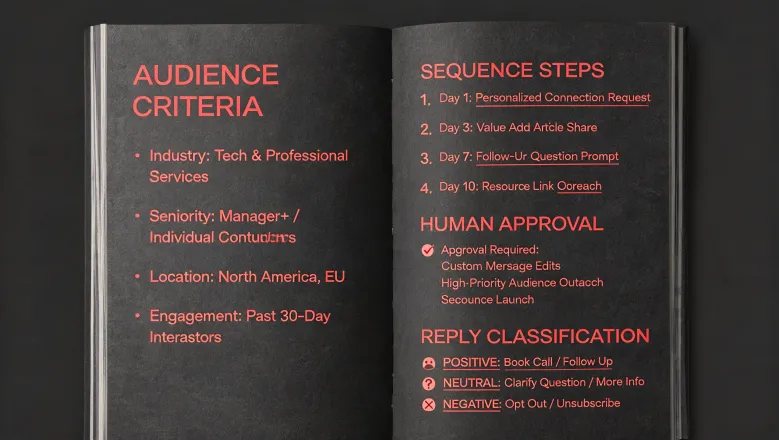
Okki Go's human review workflow is not an extra checkbox. It's the center of the product. The AI agent does research, then waits. An SDR can approve the message, edit it, or reject it.
I signed up. The first week was humbling. We caught emails with outdated job titles, a sequence directed at the wrong account, and a LinkedIn invitation that would have reached a CEO who publicly said they weren't looking. Nothing sent itself.
That's what an agent-native prospecting workflow should look like.
How AI sales assistant features fit into an agent-native prospecting workflow
That experience answered the question I had been asking for months: how does AI sales assistant features fit into an agent-native prospecting workflow?
An AI sales assistant is useful when it does the work your team doesn't have time to do well: finding accounts, verifying email, researching signals, drafting copy. It becomes dangerous when it also controls the final send.
In an agent-native prospecting workflow, the assistant is like a junior analyst. It prepares a recommendation and hands it over for review. The human decides if the target is right, if the message is true, and if the timing makes sense.
Agents can be autonomous up until the point where a decision touches a real person. After that, you need a human in control.
What I'd tell anyone comparing Okki Go alternatives
If you're reading this because you typed 'okki go alternatives' into Google, stop focusing on pricing tiers for a second. Run one test.
Ask the AI to build a list and draft a three-touch sequence. Then look at what happens next.
Does it go straight to your prospects? Can you see why each contact was selected? Can you edit before it sends? Does the tool show you the sources behind its recommendation? If the answer to the first question is yes and the rest are no, you're buying the same problem I created.
I don't think automation is bad. I think unattended automation is bad. The difference is a review workflow.
Okki Go is not the only tool with AI features. But Okki Go's human review workflow is the reason it stayed on our stack after the pilot. It treats AI as a way to make better decisions, not a way to avoid making them.
That's the lesson I wish I'd learned before the Tuesday morning with the yellow warning banner. It cost me a lot to learn. Hopefully it saves you the same mistake.

Julian Hartwell
Julian Hartwell is an independent B2B sales intelligence analyst covering contact databases, company data, decision-maker profiles, direct dials, prospect lists, and buying signals. He applies the ISO/IEC 25012 data-quality model while examining field accuracy, coverage, freshness, duplicate rate, match confidence, and source transparency. His evidence-led guides help revenue teams compare prospecting platforms, define acceptable data thresholds, and build account lists that support reliable territory planning and outreach.