LinkedIn outreach method note
OKKI Go Workflow for Founders: What Should RevOps Teams Evaluate in Hard Bounce Rate?
· Julian Hartwell
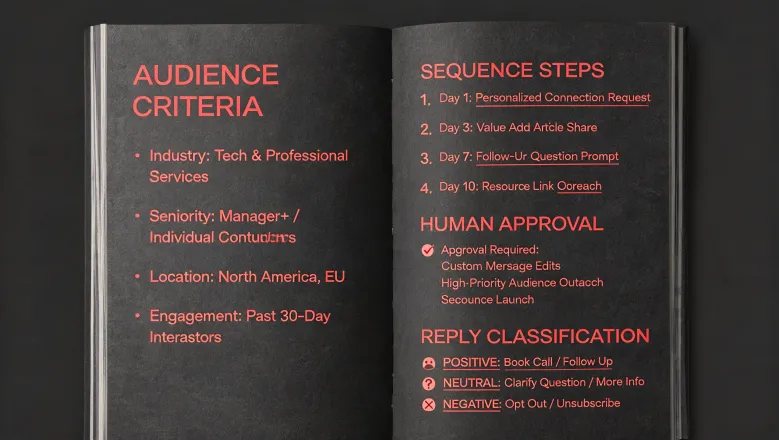
Every sales AI demo includes the same slide: “90%+ deliverability.” When I ask how that number is calculated, the answer usually gets vague. Meanwhile, hard bounce rate—the metric that actually determines whether you’re damaging your domain—stays buried in the appendix.
So what should revenue operations teams evaluate in hard bounce rate? The honest answer: it depends. I’ve spent six years on the operational side of B2B sales tech, evaluating prospecting platforms and managing data vendor relationships. Roughly $130,000 a year moves through my approval process. When I look at a platform like OKKI Go, I don’t ask “does it work?” I ask “what breaks when we scale this?”
Hard bounces are a useful starting point because they’re binary. Unlike open rates or reply rates, a hard bounce means the address doesn’t exist, and the mailbox provider knows it. Push too many, and your domain reputation drops. Recovering takes weeks—not days. But “too many” isn’t the same number for every team.
Three Scenarios, One Metric
When I guide internal teams through tool evaluations, I split the outbound maturity curve into three scenarios. Each one has a different relationship with lead generation quality and a different definition of an “acceptable” hard bounce rate.
Scenario A: Founder-Led Outbound and the OKKI Go Agent Workflow
If you’re a founder building your first outbound motion, you’re probably handling lead generation, list building, writing, and follow-up yourself. You might be using an AI SDR agent to research prospects and draft personalized messages. That’s the core of the OKKI Go agent workflow for founders: define your ideal customer profile, and the agent builds a list around it.
At this stage, the most important thing to evaluate is the absolute hard bounce rate. If you’ve never sent cold email from your primary domain, there’s no reputation cushion. One poorly sourced list can leave a permanent stain on your deliverability before you’ve had a chance to iterate.
What you should check:
- Hard bounce rate per campaign. Most deliverability guidance suggests staying under 2% for cold outreach (as of 2025; thresholds vary by provider). If you’re above that, stop sending and investigate the list source.
- Bounce messages, not just totals. A “550 mailbox not found” tells you the address doesn’t exist. A delayed response is not the same thing.
- Verification timing. Were emails validated at the moment of enrichment, or are you sending to addresses that were checked months ago?
The OKKI Go workflow for founders matters here because it routes validated contacts into a sendable list, while unverifiable emails get quarantined before the agent initiates contact. The human-in-the-loop step lets you review the final list before anything goes out. That’s meaningful when you don’t have a RevOps team to babysit data quality.
To be fair, no platform—including OKKI Go—can guarantee zero bounces. People change jobs, companies shut down, inboxes get deleted between verification and send. What matters is whether the workflow minimizes those risks by design, not by accident.
I remember skipping this review step once because we were rushing toward a product launch deadline. I knew I should manually spot-check the list before approving. But I thought, “what are the odds?” Well, the odds caught up with me. A handful of bad emails on a newly warmed domain produced a 7.4% hard bounce rate on the first send. It took two weeks of careful warm-up to dig the domain out of that hole (which, honestly, felt like forever).
Scenario B: Early RevOps Teams and Segmented Bounce Analysis
Now let’s say you have one or two people dedicated to revenue operations. You’re running multiple campaigns across multiple ICPs, and lead generation has moved past the “one list” phase. Your team is starting to use intent data to prioritize accounts, and your sales AI platform is expected to contribute to prioritization, not just volume.
For a small RevOps team, the question shifts. You should no longer ask “what’s my overall hard bounce rate?” Instead, ask “where are the hard bounces coming from?”
This clicked for me during a side-by-side review of our own campaigns. Same tool, different data segments. One segment built from third-party intent sources had a 4.1% bounce rate. Another built from our CRM’s historical data had 1.2%. If I’d only looked at the aggregate, the number would have looked acceptable. The segmented view exposed a sourcing problem.
What you should evaluate at this stage:
- Bounce rate by ICP or list segment, not just campaign-level totals.
- Waterfall enrichment coverage. Does your lead generation platform check multiple data providers in sequence, catching records that any single source would miss?
- Suppression behavior. Are unverifiable emails automatically excluded from outreach, or do they sneak back in through a fallback intent source?
This is where OKKI Go’s waterfall enrichment changes the conversation for RevOps. The platform cycles through data providers in a defined order; if one lacks a match, it tries the next. What I mean is, coverage matters more than any single provider’s self-reported accuracy. And because the AI agent logs which provider verified each record, your team can audit the entire validation chain.
The human-in-the-loop design fits a small team’s workflow too. It doesn’t claim to replace RevOps. It does the repetitive work, flags uncertain emails for review, and lets you set custom suppression logic based on your risk tolerance.
Scenario C: Scaling Outbound with Serious Sender Reputation at Stake
At the upper end, you might have a full revenue operations team, multiple sending domains, and campaigns touching hundreds of thousands of records. At this scale, hard bounce rate evaluation becomes less about individual campaign thresholds and more about trend analysis.
Put another way: stop obsessing over a single campaign’s bounce rate. Obsess over the four-week moving average per sending domain.
What to evaluate:
- Hard bounce trends by domain. If only one domain is degrading while others stay healthy, the issue isn’t list quality—it’s sending rhythm or infrastructure hygiene on that domain.
- Provider-level responses. Microsoft, Gmail, and Yahoo treat bounces differently. A single “overall bounce rate” metric can hide which provider is starting to throttle you.
- Time to detection. What’s the process for noticing a hard bounce spike within 24 hours? Are your alerts automated, or would the RevOps team spot it in a weekly report?
I still kick myself over an incident in 2024. We launched a large campaign using a vendor that said “verified.” We didn’t have segmented dashboards configured. By the time someone noticed reply rates trending to zero, our secondary domain was already on two blocklists. Recovering took 11 weeks—and that time isn’t coming back.
At this scale, a tool like OKKI Go handles email validation differently. The AI agent can pause a sequence when bounce metrics cross a threshold you’ve defined, then notify the RevOps team. It doesn’t only execute; it reports back with context. Features like that matter more than any “industry-leading accuracy” promise.
How To Tell Which Scenario You’re In
Here are five questions I use when evaluating sales tech for our own workflows:
- Who would know within 24 hours if the hard bounce rate doubled?
- Can you name which data providers validated your last imported list?
- Do all of your campaigns share one sending domain, or do you have multiple?
- When an email hard bounces, is that event automatically recorded in your CRM or sales engagement tool?
- If you saw a 5% bounce rate tomorrow, would you know whether it came from one bad segment or systemic list decay?
If you’re answering these questions like someone in Scenario A, you’re likely a founder relying on the OKKI Go agent workflow to build and validate lists. Your priority should be transparency: choose a lead generation platform that surfaces validation status clearly rather than hiding it behind a “verified” checkbox.
If you’re in Scenario B, you need segment-level bounce reports and verification source filtering. Ask vendors for a sample data response that includes provider-level detail—not just a boolean field that says “email_validated: true.”
If you’re in Scenario C, focus on automation controls. Can the AI agent be instructed to halt a sequence after exceeding a configurable bounce threshold? Can the RevOps team review and override the agent’s suppression decisions? If the answer is no, keep evaluating.
Hard bounce rate isn’t just a metric. It’s a health indicator for how professionally you’re treating prospects’ inboxes—and by extension, how you treat the people inside them. Lead generation tools get scored on how many contacts they find. What separates good ones from great ones is how carefully they treat the contacts that don’t exist.
I have mixed feelings about AI-powered outbound, honestly. On one hand, it has removed the most tedious parts of prospecting and made founder-led sales possible in a way that wasn't realistic five years ago. On the other hand, I trust AI more when it’s honest about its limits. That’s why the human-in-the-loop model makes sense to me—not because it’s perfect, but because it treats email validation as a process, not a guarantee.

Julian Hartwell
Julian Hartwell is an independent B2B sales intelligence analyst covering contact databases, company data, decision-maker profiles, direct dials, prospect lists, and buying signals. He applies the ISO/IEC 25012 data-quality model while examining field accuracy, coverage, freshness, duplicate rate, match confidence, and source transparency. His evidence-led guides help revenue teams compare prospecting platforms, define acceptable data thresholds, and build account lists that support reliable territory planning and outreach.