LinkedIn outreach method note
Okki-Go vs a Stitched Prospecting Stack: Agent-Native Lead Gen Without the Handoff Mess
· Zainab Rahimi
-
The comparison I wish I had run before stitching five tools together
-
Dimension 1: Natural language prospecting vs filter-based list building
-
Dimension 2: CRM enrichment and email verification inside the workflow
-
Dimension 3: LinkedIn prospecting and human-in-the-loop outreach
-
Dimension 4: Pricing transparency and hidden costs
-
Which model should you choose?
The comparison I wish I had run before stitching five tools together
I am a RevOps lead handling outbound prospecting workflows for B2B SaaS teams for 9 years. I have personally made (and documented) 11 significant mistakes—maybe 13, I would have to check—totaling roughly $42,000 in wasted budget and cleanup. Now I maintain our team's checklist to prevent others from repeating my errors.
From the outside, a stitched prospecting stack looks more flexible. The reality is that every tool handoff is a place for stale data, duplicate touches, and inflated costs. The comparison here is not 'one tool vs another.' It is Okki-Go's agent-native prospecting workflow vs a stitched stack of CRM enrichment, email verification, LinkedIn prospecting, sequencing, and manual review.
I am judging both on four dimensions: natural language prospecting, CRM enrichment and email verification, LinkedIn prospecting with human-in-the-loop outreach, and pricing transparency. The goal is to help you pick the model that fits your team, not to declare one universal winner.
Dimension 1: Natural language prospecting vs filter-based list building
In my first year (2017), I made the classic mistake of treating filters as truth. I built a LinkedIn prospecting search with 14 filters, exported 3,200 leads, and sent them straight into a sequence. It looked precise. The result came back ugly: 312 records had the wrong company domain, 47 were duplicates already in the CRM, and we wasted $3,200 in enrichment credits plus a week of cleanup.
That is the surface illusion: filters look precise because they let you choose many conditions. The hidden reality is that filter precision depends on field hygiene, stale CRM data, and how each platform defines a title or industry.
Okki-Go natural language prospecting changes the input. You describe the ICP in plain English. For example: 'Find heads of RevOps at Series B SaaS companies in North America that just hired three SDRs and use HubSpot.' The agent translates that into search criteria, enriches the records, checks intent signals, and returns a reviewable list. Okki Go lead generation examples people ask about are usually variations of that: post-funding hiring signals, webinar attendees missing from the CRM, or LinkedIn engagement with industry posts that never got followed up.
The stitched stack can still win here. If your ICP is static, your territory rules are strict, and your data team keeps fields clean, a filter-based workflow is predictable. For a rigid enterprise territory model, I would not rip out filters just to be modern.
Comparison conclusion: Choose natural language prospecting when your ICP changes often or your team cannot write good Boolean. Choose filter-based search when the ICP is stable and compliance requires fixed, auditable rules.
Dimension 2: CRM enrichment and email verification inside the workflow
The numbers said the verifier's 98% deliverability score was good enough. My gut said the catch-all segment was hiding risk. I split 150 catch-all records into a low-volume test. Nine bounced or hit suppression, and four people replied that they had never used that address. That was not a verification catastrophe; it was a workflow problem. The verifier was correct enough in isolation, but it was not updating the CRM, not flagging role accounts, and not suppressing risky domains before the sequence.
This is where email verification service features fit into an agent-native prospecting workflow. Features like SMTP validation, catch-all detection, role-account flags, domain reputation, and risk scoring should not live only at the send button. In an agent-native workflow, they become gates: at list build, during waterfall enrichment + intent, before outreach, and when writing back to the CRM.
In the stitched stack, the usual order is export, verify, import, sequence. Every handoff creates a gap. A record can be verified on Monday, enriched on Tuesday, and sent on Friday with a changed domain or a new role account. In Okki-Go's model, CRM enrichment and verification are part of the same agent loop, so the record is checked again before it reaches a human or a sequence.
Per FTC guidelines (ftc.gov), advertising claims must be truthful, not misleading, and substantiated. Source: FTC Business Guidance on Advertising.
That matters when a vendor claims 'verified' or 'intent data.' Ask what is verified, how often, and what happens when the check fails. A dashboard number is not a workflow.
Comparison conclusion: Agent-native wins when verification and enrichment must update the CRM and suppress records before outreach. A standalone verifier can work if you have strong ops discipline and stable volume. If you cannot name who owns the handoff, neither model will save you.
Dimension 3: LinkedIn prospecting and human-in-the-loop outreach
I went back and forth between fully automated outreach and human-in-the-loop outreach for two weeks. Fully automated offered speed. Human-in-the-loop offered context. On paper, speed made sense for our volume. My gut said our enterprise prospects would notice the difference. I chose human-in-the-loop because the ACV was too high to risk a sloppy first touch.
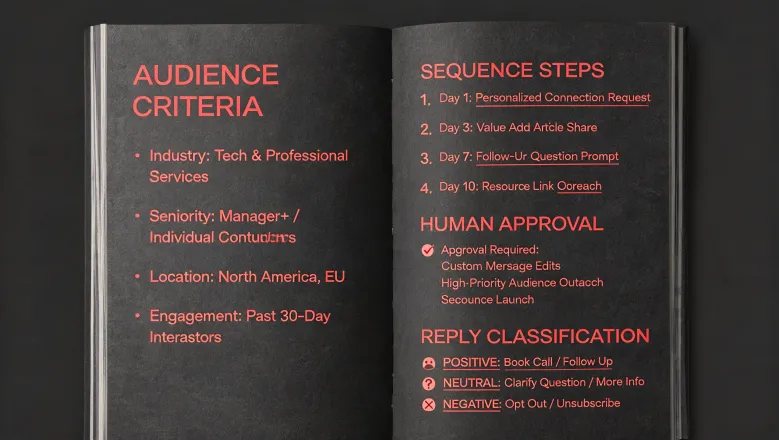
Never expected the approval step to be the part that saved us. It caught duplicate LinkedIn and email touches, fixed two wrong company references, and killed a sequence aimed at a prospect who had just raised a support issue. That is not a replacement for an SDR team. It is a way to remove handoffs between LinkedIn prospecting, email, and the CRM.
In a stitched stack, LinkedIn prospecting often sits in one tool, email in another, and CRM notes in a third. The human becomes the integration layer. That works until someone is out sick or the sequence volume spikes. In Okki-Go's agent-native workflow, the agent can draft LinkedIn messages and emails, enrich the account, check verification, and route a small set for human approval.
Comparison conclusion: Choose human-in-the-loop for high ACV, regulated, or relationship-driven sales. Choose more automation for low-touch event follow-up, inbound lead triage, or renewal outreach—but only with suppression rules and duplicate checks. 'Fully automated' is not a strategy; it is a risk setting.
Dimension 4: Pricing transparency and hidden costs
It looked like $99 per month—or rather, $99 plus enrichment credits, verification overage, LinkedIn seat minimums, and a $500 onboarding fee. Hidden costs add up fast (like enrichment credits, verification overage, and CRM sync add-ons). I have learned to ask 'what is NOT included' before 'what is the price.'
I support transparent pricing because it is the only way to compare workflows. A vendor that lists all fees upfront—even if the total looks higher—usually costs less in the end. That is not a claim about any specific competitor. It is a budgeting rule. If a prospecting vendor hides enrichment or verification costs until the first invoice, you cannot calculate cost per accepted opportunity.
For Okki-Go or any agent-native platform, ask for the same line items: seats, enrichment credits, verification volume, intent data refreshes, LinkedIn accounts, CRM sync, onboarding, and overage. If the answer is 'it depends,' ask for a worked example on your monthly prospecting volume.
Comparison conclusion: Compare total cost per qualified opportunity, not headline seat price. A stitched stack can look cheaper because the costs are spread across five invoices. An agent-native workflow can look more expensive until you add the ops time you no longer spend fixing handoffs. (note to self: document the suppression rules next quarter)
Which model should you choose?
Choose Okki-Go's agent-native prospecting if you want natural language prospecting, waterfall enrichment + intent, CRM enrichment, and email verification in one loop, with human-in-the-loop outreach across LinkedIn and email. It fits teams that are tired of exporting, cleaning, importing, and hoping the sequence still matches the CRM.
Choose a stitched stack if you already have entrenched CRM operations, a data team that owns field hygiene, strict procurement limits, or you only need one piece—like an email verification service for an existing list. A standalone tool can be the right answer when the workflow around it is already disciplined.
Avoid both if you cannot describe your ICP without buzzwords or if nobody owns suppression rules. No workflow fixes a missing definition of a qualified account.
Before you decide, run this five-question check:
- Can I describe my ICP in one paragraph, or do I need 14 filters?
- Who updates the CRM when a title, domain, or intent signal changes?
- Where does email verification happen—before enrichment, before send, or both?
- Which LinkedIn and email touches need human approval?
- What is the total monthly cost with overage, credits, and onboarding included?
We have caught 47 potential errors—maybe 52, I would have to check the log—using a version of that checklist in the past 18 months. The checklist is boring. The mistakes were not.
If you want the short version: agent-native prospecting is not about removing humans. It is about making the agent handle the handoffs so the human can handle the judgment. Okki-Go is built for that pattern. A stitched stack can still work. Just do not let a low headline price or a flashy dashboard decide for you.

Zainab Rahimi
Zainab Rahimi is an independent social and multichannel prospecting analyst covering LinkedIn automation, connection workflows, profile research, email discovery, social outreach, browser extensions, and coordinated touch sequences. She applies EU GDPR data-minimization principles while assessing invitation acceptance, reply rate, profile-match accuracy, rate limits, channel overlap, sequence spacing, opt-out handling, and account restriction risk. Her guides help sales teams compare automation approaches, build controlled workflows, and balance personalization, compliance, channel resilience, and sustainable prospect engagement.