LinkedIn outreach method note
What Permissions Does Okki Go Require? Plus Buying Intent Signals and LinkedIn Scraping
· Julian Hartwell
-
1. What Permissions Does Okki Go Require?
-
2. Okki Go Alternatives for Agent-Native Prospecting: What Should I Compare?
-
3. What Is a Buying Intent Signal, Actually?
-
4. Which Buyer Intent Data Providers Should an Agent Actually Use?
-
5. How Does LinkedIn Scraping Fit Into an Agent-Native Prospecting Workflow?
-
6. Is Paying for a Faster Setup Worth It When You Are Under a Deadline?
Evaluating Okki Go usually starts with a demo. In my experience, it should start with a permissions review. I talk about this because I connected an AI sales agent to the wrong mailbox once. Not the proudest moment. Since then, I've evaluated enough tools to know the AI isn't the risky part. Permissions, data sources, and handoff logic are the risky parts.
I've spent roughly seven years in RevOps and operations for B2B teams. I've also made enough expensive mistakes with prospecting tools to keep a checklist. This FAQ follows that checklist, in the order I wish I'd used it.
1. What Permissions Does Okki Go Require?
Okki Go's permission flow is modular. In the setup I reviewed most recently, it asked for the minimum permissions needed for the connectors I enabled. If you only connect an email mailbox, the permission scope is smaller. Connect a CRM and Slack, and the scope grows.
- Email mailbox access. This is the critical one. Gmail or Microsoft 365 lets the agent compose and send messages. It may also read replies to keep the conversation moving. If auto-send is switched on, no human looks at every message before it goes out.
- CRM access. Okki Go reads or updates contacts, deals, and activity history depending on the CRM connection. This is how it deduplicates and hands off to a human SDR.
- LinkedIn OAuth. If you activate the LinkedIn connector, the app asks for access through LinkedIn's official authorization flow. It does not ask for your password or full Company Page admin rights.
- Enrichment or intent provider access. When you attach data providers, the platform gets fields from them so the agent can enrich and score records in one workflow.
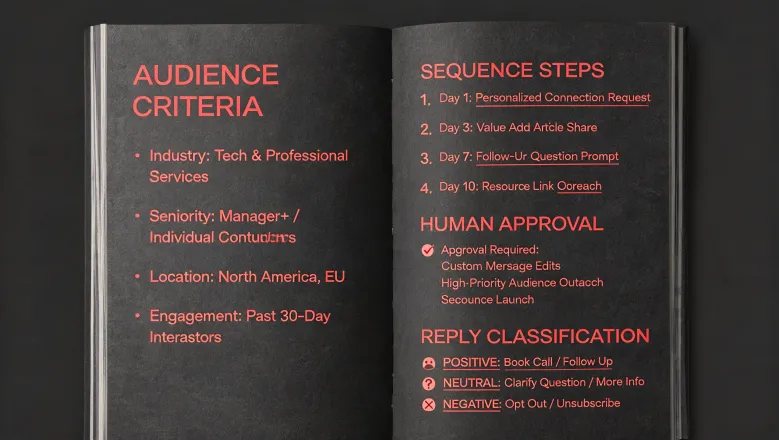
Asking 'which tabs are these?' misses the point. The question I now ask is: does the tool have a human-approval step? For the first two weeks, keep the agent in draft or require manual send. It limits speed, but it protects your sending reputation.
2. Okki Go Alternatives for Agent-Native Prospecting: What Should I Compare?
Agent-native means a bit more than 'has AI.' It means the agent can carry the entire workflow: identify accounts, enrich them, write personalized messages, decide not to send, read replies, and hand off to a human. An agent-native workflow is not a sequence with a text generator bolted on.
Okki Go alternatives for agent-native prospecting appear all over the market. Some are platform-native, some are CRM-native, and some are DIY workflows built with APIs. I've tested tools that look identical in a demo: same tone, same personalization, same claims. The difference appeared after the first week.
My evaluation checklist:
- Can I see what it plans to send? If the answer is 'you'll see it after launch,' that is not a guardrail.
- Can I stop after the first batch? A human-in-the-loop gate is not a feature to hide. It is a requirement for outbound.
- What happens to replies? Who owns a meeting request? Does the agent log it to the CRM and alert the owner, or does the thread disappear?
- Where do the emails come from? Verification before send matters more than personalization.
I have tested Artisan and 11x as two examples of comparable tools, but this isn't a recommendation list. It is a reminder: if you can't find the approval toggle, you are buying a promise, not an agent. The rest is just copywriting.
3. What Is a Buying Intent Signal, Actually?
A buying intent signal is evidence that a company is actively researching a problem or solution. It is not the same as general web traffic, and it is not the same as a firmographic fit. A person can fit your ICP and never search for what you sell.
The useful signals fall into two groups. First-party signals come from your own property: repeat visits from a target account to your pricing page, a product tour followed by an absence, a request for ROI details. Third-party signals are purchased from intent data networks that observe aggregated company research across many websites.
A buying intent signal should make your agent more careful, not less. In my early AI experiments, I used a single apparent signal to justify an automatic sequence. The result was predictable: the account was researching the category because they are a consultant writing a report on it, not because they're buying it. The signal was valid, but the interpretation was wrong.
Intent data is helpful when combined with other signals: job changes, content from your email, site behavior. In my stack, an agent can tag an account as 'intent detected' only after a human approves what the signal means.
4. Which Buyer Intent Data Providers Should an Agent Actually Use?
It is tempting to connect buyer intent data providers in bulk. This is the area where vendors spend a lot of time and where teams get the least value. In an agent-native workflow, the data source needs to be able to export raw signals that the agent can consume.
Common buyer intent data providers include Bombora, 6sense, G2, and ZoomInfo. I'm not going to name a winner here; the right provider depends on your ICP. The question I ask is: does the provider give you a clean score or topic code that the agent can use in routing? If it only lives in one dashboard, it won't help.
When the deadline is tight, use one third-party intent provider and one first-party source. More providers create more noise and more integration delay. Buy enough intent data to make an AI agent work, not enough to drown your handoff queue.
5. How Does LinkedIn Scraping Fit Into an Agent-Native Prospecting Workflow?
Short answer: it shouldn't. At least not automated scraping. According to LinkedIn's User Agreement, scraping profiles without written permission is prohibited. You may see vendors call it 'lead generation' or 'account research,' but from a risk perspective, it's a time bomb.
When I started in outbound, I used a LinkedIn scraper to load lists into a cold outreach sequence. It worked for a while. Then the tool's connection to LinkedIn started failing, data gaps appeared, and we couldn't run the same campaign again. We lost two weeks. The problem was not that the emails were bad. The problem was uncertain access: the data source could disappear at any moment, which is worse when a deadline exists.
LinkedIn can still fit into an agent-native workflow through the official OAuth path. The agent can use profile context from accounts already in your CRM, for example, and a human can review before scheduling. But if you need an email address, use an enrichment provider and a verification step. That makes the entire process more stable than scraped data.
Does LinkedIn scraping fit into an agent-native workflow? Only if you mean native integration. Scraping is not a data strategy.
6. Is Paying for a Faster Setup Worth It When You Are Under a Deadline?
Usually, yes. Paying for setup is not paying for speed; it is paying for certainty. In Q1 2024, my team skipped the white-glove setup to save money before a partner event. The implementation itself was fine. But IT asked a simple question about permissions, the vendor's generic answer did not cover our configuration, and the delay ate the test window. We missed the event outbound deadline. The fee we saved was less than the cost of one wasted hour of the whole team.
When comparing Okki Go alternatives for agent-native prospecting, ask whether the paid onboarding includes: security review, permission planning, a sample of 20 records, and a send test before you launch. If yes, it is not an upsell. It is insurance.
The top mistake is assuming that a more autonomous agent means less setup work. In practice, autonomy without guardrails creates chaos. The agent can write and send messages fast. A two-week crunch is exactly when you don't want to figure out permissions at the last minute. I now treat 'can it be controlled' as the first feature. It is better to have an agent that waits for a human review than one that never waits and cannot be stopped.

Julian Hartwell
Julian Hartwell is an independent B2B sales intelligence analyst covering contact databases, company data, decision-maker profiles, direct dials, prospect lists, and buying signals. He applies the ISO/IEC 25012 data-quality model while examining field accuracy, coverage, freshness, duplicate rate, match confidence, and source transparency. His evidence-led guides help revenue teams compare prospecting platforms, define acceptable data thresholds, and build account lists that support reliable territory planning and outreach.