LinkedIn outreach method note
When Should a B2B Sales Team Use an AI Sales Assistant? Our okkigo Pilot, From Install to Outbound
· Julian Hartwell
-
Last January, I watched three SDRs fight the same spreadsheet
-
What are AI sales assistant features—and when should a B2B sales team use them?
-
It’s tempting to think an AI SDR is just email automation on autopilot
-
How to run the okki go install command (the easy part)
-
Okki go data enrichment: what waterfall actually means
-
Sales prospecting features we actually used
-
Email automation only worked because people stayed in the loop
-
When should a B2B sales team use an AI sales assistant?
-
A lesson I’d share with any operations person
Last January, I watched three SDRs fight the same spreadsheet
One was copying company names from LinkedIn. Another was guessing email formats from a domain. The third was about to send a personalized note to a “VP of Sales” who had left the company two years earlier.
I manage office administration and software purchasing for a B2B SaaS company, so when a new tool needs evaluating, it usually lands on my desk. That spreadsheet moment is how we ended up testing okkigo—not because an AI sales assistant sounded exciting, but because manual prospecting had quietly become the bottleneck for our outbound team.
What are AI sales assistant features—and when should a B2B sales team use them?
Our VP asked me that exact question after a quarterly planning meeting. I didn’t have a clean answer at the time. I knew what our SDRs did every morning: build lists in LinkedIn Sales Navigator, try to match contacts against our ICP, enrich them by hand, write a first line, send, hope, follow up, repeat.
It worked. It just didn’t scale.
The question stayed with me as I compared tools. What I found was not what I expected.
It’s tempting to think an AI SDR is just email automation on autopilot
That’s the simplified version. What I discovered is that an AI sales assistant earns its keep earlier in the funnel: researching accounts, cleaning data, and helping reps prioritize who to contact. Email automation still matters, but it’s the last mile, not the whole race.
I went back and forth between two approaches for almost a week. Option A was a standalone enrichment tool plus the email software we already used. Option B was a fuller AI SDR platform. On paper, Option A was cheaper. But it meant more integrations, more tabs, more CSV exports—the exact mess we were trying to escape.
okkigo combined prospecting, enrichment, intent signals, verification, and email automation in one workflow. I admit the phrases “agent-native prospecting” and “human-in-the-loop outreach” caught my attention. That sounded like a research assistant, not a spam cannon.
How to run the okki go install command (the easy part)
Confession: when I searched for “how to run the okki go install command,” I expected an enterprise setup with a dedicated support engineer. Instead, it took about three minutes.
You copy one line from the official Quickstart docs, run it in your terminal, and authenticate with your workspace. The exact command isn’t something you need to memorize—it’s in the okkigo documentation and it changes as the product evolves. Copying commands from blog posts is how outdated setup guides are born.
(I really should have timed the setup. Our SDR lead and I kept laughing about how older sales tools took longer to schedule a demo than okkigo took to install.)
And for anyone searching “okki-go,” “okki go,” or “okkigo”: same platform. Our internal Slack uses all three spellings, so no judgment.
Okki go data enrichment: what waterfall actually means
Searching for “okki go data enrichment” surfaces plenty of marketing language. Let me translate the term that mattered most: waterfall enrichment.
The simple mental model is one database lookup, done. The real world is messier. One source might have an old job title. Another might have a generic company phone number. A third might be missing an email entirely. Waterfall enrichment checks multiple sources in sequence—i.e., it keeps building the record until it finds the best available information.
We saw this immediately in our pilot. Our CRM listed a VP of Sales at one target account. okkigo enriched the same person and flagged that she had recently moved into a revenue operations role. Same company, different buying influence. The original email would have been polite, relevant-ish, and wrong.
Email verification was also part of the flow, which matters for cold outreach. No platform can guarantee deliverability—if someone claims that, treat it as a red flag—but catching bad addresses before they go out is a real step forward.
Sales prospecting features we actually used
We kept the pilot intentionally small: 40 named accounts, two SDRs, one AE. I didn’t want the team to feel like lab rats. The question was whether okkigo’s sales prospecting features would reduce manual busywork without making the outreach sound like a robot wrote it.
Three features made the biggest difference:
- Research and prioritization: The SDRs started with a ranked list of accounts that matched our ICP. okkigo pulled recent hiring activity, company changes, and other signals, so they weren’t staring at a blank LinkedIn profile.
- Waterfall enrichment with verification: The quiet hero. Clean data isn’t exciting until you stop wasting time on wrong phone numbers and stale domains.
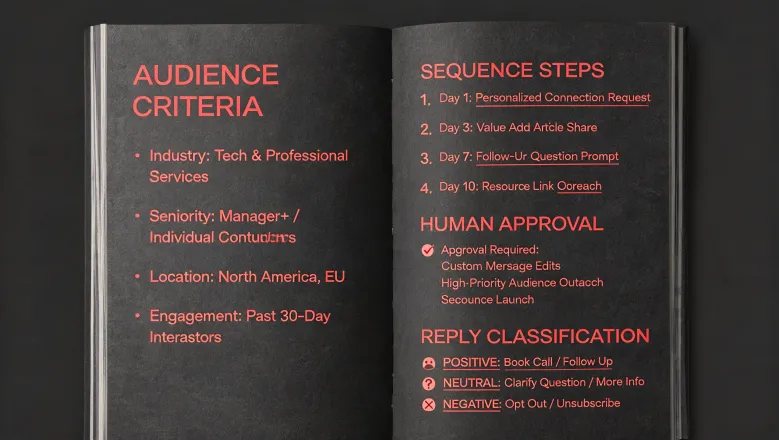
- Human-in-the-loop email automation: The platform drafted personalized messages based on its research. Then a human edited and approved each one. That review step isn’t a drawback; it’s the point.
Email automation only worked because people stayed in the loop
I get why email automation has a bad reputation. Most of the time it’s associated with quantity over thoughtfulness. What okkigo did differently was generate drafts from account research, not just marry a first name to a template.
Did it replace our SDRs? No. Did it change the shape of their day? Yes. They spent more time deciding what to say and less time hunting for data. From my perspective, that’s a win.
When should a B2B sales team use an AI sales assistant?
I’m not going to tell every sales team to buy one. The honest answer is that AI sales assistant features help when you already have a repeatable outbound motion and a clear ICP. If you don’t know who you’re selling to, the AI just automates the confusion.
Here’s the checklist I would use:
- You have a defined ICP and an outbound process that already produces meetings—but it doesn’t scale.
- Your reps lose at least an hour or two per day to manual research, enrichment, or data entry.
- You’re willing to keep a human responsible for the final message. Human-in-the-loop may sound limiting, but it protects your sender reputation and forces relevance.
- You need more than contact data. Account-level intent data would help your AEs prioritize.
Mainstream sales technology research—including Salesforce’s State of Sales and Gartner’s sales tech coverage—has pointed the same direction for years: AI is moving from isolated point tools toward assistant-style workflows. What reports don’t tell you is that the operator still matters. okkigo handles the parts that wear humans out: research, enrichment, prioritization, and follow-through. Humans handle judgment.
A lesson I’d share with any operations person
By March, I walked past the SDR pod and noticed the change. Two reps were on calls. One was reviewing drafts in okkigo and approving messages. Nobody was staring at a maze of spreadsheets. Not a dramatic transformation, but exactly what we were hoping for.
If you’re evaluating tools like okkigo, start with the question: what should the AI own, and what should the humans check? The install command was the easy part. Getting that balance right is the real work.

Julian Hartwell
Julian Hartwell is an independent B2B sales intelligence analyst covering contact databases, company data, decision-maker profiles, direct dials, prospect lists, and buying signals. He applies the ISO/IEC 25012 data-quality model while examining field accuracy, coverage, freshness, duplicate rate, match confidence, and source transparency. His evidence-led guides help revenue teams compare prospecting platforms, define acceptable data thresholds, and build account lists that support reliable territory planning and outreach.