LinkedIn outreach method note
Fitting a Professional Email Finder Into an Agent-Native Prospecting Workflow: An 8-Step Buying Checklist
· Sora Nishimura
-
What this checklist is for
-
The 8 steps
-
Step 1 — Write the output spec before you look at any demo
-
Step 2 — Audit what you're already paying for, including manual labor
-
Step 3 — Put your verification standard in the procurement doc, and never accept "100% accurate"
-
Step 4 — Map your human-in-the-loop checkpoint (the step most people skip)
-
Step 5 — Run the API integration against 500 records on a test key, not 50,000 in production
-
Step 6 — Benchmark waterfall enrichment and intent data on the same sample
-
Step 7 — Compute 12-month total cost, not the seat price
-
Step 8 — Define your quality gates and rollback triggers before launch
-
Step 1 — Write the output spec before you look at any demo
-
Common mistakes that eat the savings
-
Bottom line
What this checklist is for
I sign off on the sales data budget at a 140-person B2B SaaS company — roughly $96,000 a year across prospecting tools, verification, enrichment, and the extra seats we keep forgetting to cancel. Over the last three years I've run six vendor evaluations in this space. Two of them ended with a decision not to change anything, which I count as a win.
This checklist is for the person who got handed a brief that sounds like "find us a better professional email finder" but is really "make the outbound motion work without doubling headcount." Eight steps, in order. The first three cost nothing and take about a week. Most teams skip them and pay for it later.
One thing up front: I'm not going to tell you which vendor to pick. I'll tell you what we picked, why, and where it bit us. Your numbers will be different.
The 8 steps
Step 1 — Write the output spec before you look at any demo
Before I take a single call, I write a one-page spec of what our agent needs to return per run. Field by field, in priority order.
Ours was: full name, company domain, title, verified work email, one recent signal (funding, hiring, tech change), and a source timestamp for each. Then one rule at the end — if any of the first four fields are missing, the record is dead.
Sounds obvious. It isn't. Agent-native workflows move fast and there's no human standing there noticing a blank field. A batch job that returns 80% complete records doesn't produce 80% of the results. It produces garbage at full speed.
Get your sales lead to sign that spec. If they won't, you don't have a requirements problem — you have a decision problem.
Step 2 — Audit what you're already paying for, including manual labor
Export your last 90 days of outbound contact records. About 2,000 rows is enough to see a pattern.
Pull three numbers:
- Hard bounce rate
- Percentage of records that got fixed by hand (a rep looking up a missing domain, re-checking an email, guessing at a title)
- All-in cost per usable record — not per record purchased
When we ran this in Q1 2026, 14% of our list-building hours were going into field repair. Call it $31,000 a year in salary, spent before any tool fee shows up on an invoice.
That number changed the whole project. We stopped shopping for "a better email finder" and started shopping for "fewer records that need repair."
Step 3 — Put your verification standard in the procurement doc, and never accept "100% accurate"
No legitimate verification vendor guarantees every address. If one does, end the call. The cost of that guarantee is either a falsified number or a contract clause written by a lawyer who knows you'll never enforce it.
Write down what you'll actually accept:
- Hard bounce ceiling (ours is 2% on cold outbound)
- Verification method — a live SMTP check is a different product from a syntax guess with a green checkmark next to it
- Re-verification cadence — anything older than 90 days is a guess
- Proof format — timestamped per-record results, exportable, not a dashboard summary
Also worth knowing: since February 2024, Google and Yahoo's bulk sender rules have pushed bounce management from "nice practice" to "your domain reputation is on the line." Check the current thresholds in Google Postmaster Tools and Microsoft SNDS before you set your ceiling, because those numbers have moved. (As of April 2026 the guidance is stricter than it was at launch.)
GDPR and CAN-SPAM don't stop you from finding a business email — legitimate interest plus a valid company address covers most B2B outbound — but they do mean you need a record of where the data came from. Make the source field mandatory in your spec. You'll want it if anyone ever asks.
Step 4 — Map your human-in-the-loop checkpoint (the step most people skip)
Here's the counterintuitive part of automation: the more you automate the workflow, the more you need one deliberate slow point in it. Not slow as in slower. Slow as in gated.
Most teams do one of two things. They add nothing, or they add everything. Then the SDRs become data entry clerks and the emails read like something assembled by a machine learning model that got bored halfway through.
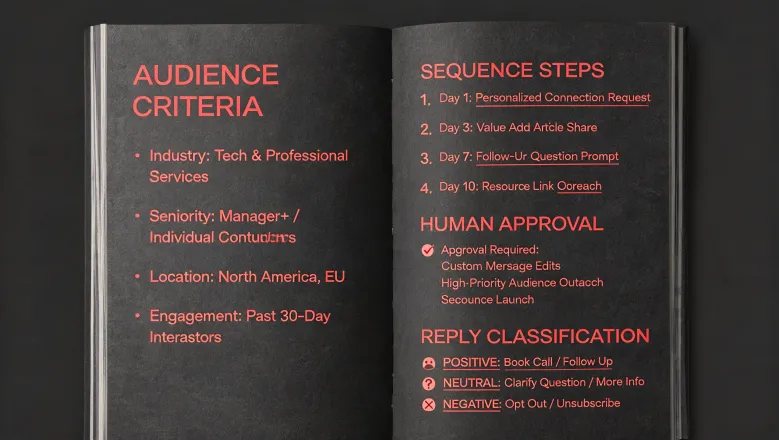
We landed on two checkpoints:
- Pre-send, record level — top accounts and anything strategically named. That's 5% of volume and about 40% of the perceptual impact.
- Post-send, exception queue — any record where a field was enriched, inferred, or just looked "a little off." Twenty minutes a day.
Why this matters more than it sounds: someone who gets an obviously auto-filled email with their name spelled wrong doesn't only remember that email. They remember your company. We ran a split test on this in 2024 — same list, same offer, one group got a human glance before send. Negative replies ("wrong person," "take me off this") dropped from 4.1% to 1.8%. Positive reply rate barely moved. The savings are in reputation, not in responses.
Step 5 — Run the API integration against 500 records on a test key, not 50,000 in production
This is where okki-go API integration actually happens. Order of operations: test token or sandbox, 500 records, field mapping that matches Step 1 exactly, then inspect what came back.
Things worth checking:
- Do address fields come back separately (street, city, region, postal) or as one concatenated string? If it's one string, you're paying engineering time to split it later.
- Are timestamps UTC or local? Sounds trivial until you're filtering on a 30-day window.
- What happens on partial failure — does a batch retry or silently drop? A silently dropping integration is worse than no integration.
- Idempotency — does re-running the same batch double-bill you?
And the part nobody wants to admit: I have skipped sandbox testing more times than I'd like to count, because the demo looked clean. One of those times an address field got silently truncated and we sent 4,000 contacts an email that opened with "Hi ,". Three sales calls that week were unpleasant. We're still stitching together that field mapping doc (I really should finish it).
Step 6 — Benchmark waterfall enrichment and intent data on the same sample
Don't compare two vendors' claimed match rates. Those numbers never share a definition. Run the test on your own list.
Take the same 500 records, run them through each provider, and count matches per field, not as a whole-record hit. A vendor that claims 70% total but only hits 40% on domain is producing noise with a nice header.
Waterfall enrichment — trying sources in sequence until one returns a match — is only as good as its later stages. If source one covers half your list and source four covers the long tail, you need to know what the long tail actually looks like before you sign a volume commitment.
Same discipline for intent data. Ask what the signal means, not how many signals exist. If it's a repackaged job title, the test won't show it — but your SDRs will feel it within a week.
And check the timestamps. A 60-day-old intent signal and a signal from yesterday are not the same product, even if they're sold under one line item.
One limitation worth stating: my experience here is about six data sources over three years, in B2B SaaS and IT services. If you sell industrial equipment into distributors who rarely change vendors, every match rate will be lower and every intent signal noisier. Run your own numbers.
Step 7 — Compute 12-month total cost, not the seat price
What actually drives the invoice, in rough order of surprise:
- Monthly platform seats
- Contact credits and overage (the fine print lives here)
- API calls
- Supplemental data — second-layer verification, phone validation, domain completion
- Admin time — someone exporting records from one system into another
- Engineering time — maintenance, retry logic, mapping fixes
- Failure cost — bounce handling, domain reputation recovery
Our 2025 evaluation: a quote that looked like $2,400/month cost us $41,800 over 12 months. The gap was $6,200 in overage, $4,100 in supplemental verification tools, and $2,700 in engineering hours.
That $6,200 was avoidable. Someone warned me that per-contact billing (meaning you pay for returned contacts, not usable ones) bites hard in an agent-native workflow because the agent volume-scales before verification happens. I didn't listen. Then I met the overage.
Build the sheet before you rank vendors. Not after.
Step 8 — Define your quality gates and rollback triggers before launch
Write down what stops the line the first time you turn it on:
- Hard bounce rate above 3% for five consecutive business days
- Verification field missing on more than 5% of records
- Exception queue above 200 records for three days running
And name the person who hits the stop button. A name, not "the team."
Without this you have two states: on and off. With it, you have a dial. Set the numbers before launch or you'll set them too loose — you'll want to keep the numbers after the money is spent.
Common mistakes that eat the savings
- Comparing vendors on cost per contact instead of cost per usable record. One is a sticker price, the other is your budget.
- Skipping the sandbox test because the demo looked clean.
- Turning SDRs into data entry. That 14% field-repair time doesn't disappear — it relocates.
- Treating intent data as real-time. Most of it isn't. Ask for median freshness, not maximum.
- Forgetting to cancel the monthly seats nobody looks at after month four.
It took me about three years and roughly $23,000 in wasted credits to understand something pretty simple: fix verification first, automate outreach second, scale third. I kept trying to do it in the other order.
Bottom line
If your agent is going to move fast, the data quality gate has to sit in front of it, not behind it — because the agent won't stop and check a name. Do the sandbox run in Step 5 properly and be honest in the Step 7 spreadsheet. The rest sorts itself out.

Sora Nishimura
Sora Nishimura is an independent cold-email deliverability analyst covering email warmup, inbox placement, sending domains, mailbox rotation, spam testing, and outbound campaign infrastructure. She relates ISO/IEC 27001 controls to credential handling while measuring hard-bounce rate, complaint rate, placement by provider, domain reputation, authentication alignment, daily volume, and recovery time. Her practical guides help growth teams configure safer sending systems, diagnose delivery failures, and scale cold outreach without confusing volume with genuine reach.