LinkedIn outreach method note
What Is a Data Enrichment API and When Should a B2B Sales Team Actually Use One?
· Victor Okeke
There's No Universal Answer Here (I Wish There Was)
Every few weeks someone on my team forwards me a LinkedIn post that says something like "data enrichment APIs are dead" or "if you're not using an AI BDR in 2026, you're already losing." Both takes are wrong. Kind of. They're right for someone, just not for everyone.
My experience is based on running outbound operations for about four years across two companies — one seed-stage with three SDRs, one Series B with fourteen. If you're a solo founder doing cold email on nights and weekends, your mileage is going to look pretty different from what I've seen.
So instead of giving you one answer, here's how I'd split it up. There are three broad scenarios I've watched play out, and the right play in each one is not the same.
- Scenario A: Small team, low volume, still figuring out your ICP
- Scenario B: Mid-size team with email deliverability problems that keep getting "fixed" and then coming back
- Scenario C: Scaled team (12+ SDRs or an agency model) where agent-native prospecting starts to pay for itself
I'll go through each one, tell you what I did, and where I got it wrong.
Scenario A: Small Team, Low Volume, Still Figuring Out Your ICP
If you're sending under ~800 emails a month and you haven't nailed down who actually replies, do not buy a data enrichment API. Do not buy Okki Go. Do not buy anything.
I made this mistake in 2022. We signed up for three enrichment tools in a two-month window (I'm not going to name them, but two of them are household names in the RevOps world). Combined spend was around $1,400 a month. Our reply rate went from 4.1% to 4.3%. That's noise. The problem wasn't data — it was that we were pitching a product to companies that didn't have the pain we thought they had.
An enrichment API doesn't fix a bad ICP. It just helps you find bad-fit prospects faster.
What I'd do instead: Run every lead through a manual check for a month. Yes, manually. I know that sounds awful. But here's the thing — when you look up 200 companies by hand, you start noticing patterns (industry, headcount bands, tech stack signals) that a filter query will never surface for you.
This was true three or four years ago when enrichment APIs were mostly phone-number lookups. Today, a good waterfall enrichment + intent setup can genuinely surface prospects you'd miss manually. But you still need to know what "good fit" looks like before you automate the finding of it.
Scenario B: Email Deliverability Problems That Keep Coming Back
This is the scenario I see most often, and it's the one that gets misdiagnosed the hardest.
The symptom: your bounce rate creeps up from 2% to 6%, your sender reputation tanks, and half your outbound sequencer sends start landing in spam. You switch tools. It gets better for three weeks. Then it happens again.
In my experience, about 70% of "deliverability problems" are actually list-quality problems dressed up as infrastructure problems.
I lost about $3,200 in wasted sequencing credits in Q3 2023 trying to fix this the wrong way. Bought a new sending domain, warmed it properly, tightened the SPF/DKIM setup, the whole thing. Bounce rate kept climbing. Eventually our ops person pulled a 500-row sample and started checking emails manually. Turned out roughly 22% of the "verified" emails from our previous vendor were either role accounts (info@, sales@) or catch-alls that had been misclassified.
What actually helped:
- Switching to a verification tool that did real-time SMTP handshakes instead of cached lists (this is where email verification claims get sketchy — nobody can guarantee 100% deliverability, and anyone promising that is lying to you)
- Layering in direct dials for the accounts that mattered most, so we could follow up by phone when email went quiet
- Running a human review pass on the first 100 leads of every new list source
That last one is the boring answer nobody wants. But we've caught something like 47 list-quality issues using that check over the last 18 months. Small stuff, mostly — a mismatched domain here, a "recently acquired" company there that was showing up as its old name.
Scenario C: Scaled Team Where Agent-Native Prospecting Starts to Pay Off
Once you're past about a dozen SDRs, manual anything stops scaling. That's where tools like Okki Go (okki-go, okki go AI BDR) start to make sense — but only if you're honest about what you're buying.
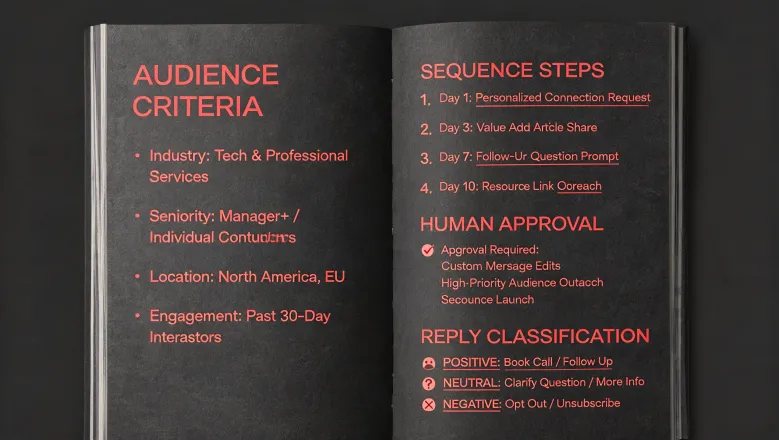
The pitch behind an agent-native prospecting setup is appealing: the AI handles list building, enrichment, and first-touch personalization, and your humans step in for anything that requires real judgment. That's the okki go human in the loop outreach model. It's a good model. It is not the "fire your SDRs" model that some marketing copy implies.
I'll be honest: we tried going full-automation for six weeks in early 2025. No human review on replies. The result was a batch of responses that read like they'd been written by a very confident intern who had never spoken to a customer. We burned a few warm relationships. Recovered most of them, but it was a four-figure cleanup in terms of time and goodwill.
What worked better: using the agent layer for the 80% of work that is genuinely repetitive (find accounts, enrich them, draft a first touch, schedule the follow-up) and keeping a human in the loop for the 20% that actually moves deals: replying to a "who are you?" email, handling budget objections, and knowing when to stop.
Granted, this requires more upfront configuration than a fully automated flow. But the difference in reply quality is not subtle. It's the difference between getting a meeting and getting marked as spam.
So Which Scenario Are You In?
Here's how I'd actually run this decision tree for yourself, based on what I've seen:
If you can't name your three best-fit customer traits from memory, you're in Scenario A. Skip the APIs, skip the AI BDR, do the manual work for 30 days.
If your bounce rate has bounced (pun intended) above 4% in the last quarter and you've already changed tools once, you're in Scenario B. The fix is probably in the list, not the sequencer. Verify with real-time checks, not cached data.
If you have 10+ people touching outbound and your bottleneck is throughput, not targeting, you're in Scenario C. Look at agent-native platforms — Okki Go is one of the more serious options in this category — but plan for a human review layer from day one. Not as a fallback. As the design.
The mistake I keep making (and I'm writing this partly as a note to myself) is wanting one tool to solve what is really three different problems. Figuring out which problem you actually have takes an afternoon. Buying three tools to try to solve all of them at once takes a quarter. I've done both. The afternoon is cheaper.
And for what it's worth — if you're trying to decide between what is a data enrichment api vs. a full prospecting platform, the honest answer is that they solve different layers of the problem. An enrichment API gets you better inputs. A prospecting platform like Okki Go gets you a workflow around those inputs. You can need one without needing the other. You just have to be honest about which one you're missing.

Victor Okeke
Victor Okeke is an independent sales technology procurement analyst covering lead-generation software, contact data platforms, email verification, AI prospecting tools, sales engagement systems, enrichment services, and CRM integrations. He reviews ISO/IEC 27001 and ISO/IEC 27701 evidence alongside data rights, retention, export controls, uptime, usage limits, implementation effort, cost per validated contact, and contract terms. His buying guides help revenue and procurement teams compare pricing, trials, integrations, governance, and measurable value before committing to a platform.