LinkedIn outreach method note
How I Configured okki-go in Our AI SDR Stack — and What a 15,000-Contact Deadline Taught Me About Email Verification Accuracy
· Julian Hartwell
Monday morning, 8:42am. Our outbound lead pings me on Slack: "We need 15,000 B2B contacts verified through okki-go before Friday. The AI SDR agent fires Monday."
I'm the quality and brand compliance manager at a mid-sized SDR enablement company — roughly 40 people, mostly in North America and Western Europe. I review every deliverable before it goes to a customer or into a live campaign. Last year that was 214 separate items: sequence copy, contact lists, intent-signal configs, enrichment snapshots. About 12% got rejected on first pass in 2025, most often for stale contact data that had never passed a real email validation service.
Fifteen thousand contacts. Four business days. A quality bar I wasn't allowed to lower.
This is what that week actually looked like — and what it taught me about why email verification accuracy matters far more than most teams think.
Setting up okki-go: the easy part
Here's the thing about configuring okki-go in an AI agent — the wiring itself is not the hard part. I had our okki-go workspace connected to the agent by Tuesday lunch.
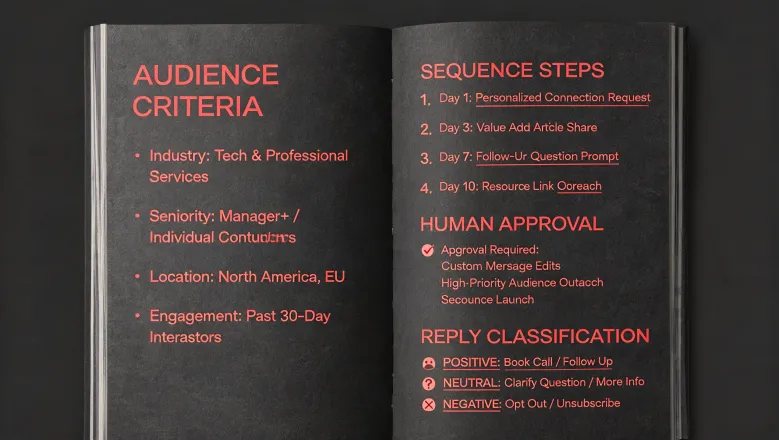
The okki go outreach preparation workflow we landed on looked like this: the agent pulls from a contact source, runs enrichment, checks against intent signals, and pipes anything that passes into a sequence. From my seat, the interesting decision was where to put verification in that chain. Most teams put it at the end, right before send. That's a mistake, in my opinion.
We placed verification before enrichment and again after a 24-hour cooldown. That second pass is what saved us. But I'm getting ahead of myself.
The vendor split — and the numbers that didn't agree
We bought the 15,000-contact batch from two suppliers. One was a dirt-cheap list broker. The other was a proper provider with a real email validation service layered on top. I ran both halves through okki-go's verification step back to back, expecting the cheap side to be maybe 5-8 points worse.
It was 19 points worse.
The premium half came back at 97.4% valid. The cheap half came back at 78.2%. Not because the underlying people were fake — many of those addresses had once been real — but because the domain-level checks the cheap side was skipping (SMTP catch-alls, recent bounce data, MX record freshness) were exactly where the rot lived.
I don't have hard data on industry-wide bounce-threshold standards, but based on what we've seen across the ~180,000 contacts we've verified since 2021, my sense is that anything below 92% verified-valid on a cold B2B send is going to damage your sending reputation within two campaigns.
FTC guidance on commercial email (ftc.gov/business-guidance) is blunt about the downstream cost: senders who tolerate high bounce rates and unclear opt-out paths are on the radar of every major ISP. Once you're on the radar, deliverability doesn't recover in a week.
The Wednesday turning point
Wednesday afternoon I ran the second verification pass, and 3,100 addresses that had passed the first check started failing — mostly because of domain-level reasons: a mail server had gone dark, two corporate domains had migrated to a new provider, and one mid-sized SaaS company had been acquired and shut down its old mail routing.
That's the part that no one warns you about. The question most teams ask is "what's our verification accuracy on day one?" The question they should ask is "how fast does our accuracy decay?"
The 'once valid, always valid' assumption comes from an era when B2B contacts stayed at the same company for five years or more. Tenure has shortened — especially in tech and consulting — and mail infrastructure moves with it. If you're verifying a list months before a send, you're verifying a ghost.
By Thursday morning we'd rebuilt the batch. We dropped the cheap-source half entirely and asked the premium vendor to re-verify a fresh pull. It cost us a rush fee — roughly $0.008 per credit instead of $0.005 — and we paid it without much debate.
Why I stopped optimizing for price
Here's what I tell people when they ask me about verification spend: cheap, fast, accurate. Pick two. In practice you're usually lucky to get one.
What I mean is that the 'cheap' validator isn't just cheaper per credit — it's cheaper because it's running a smaller set of checks, refreshing its data less frequently, and skipping the expensive catch-all and role-account resolution that actually makes your deliverability hold. The per-credit difference looks like rounding error. The downstream cost looks like a $9,000 campaign that nobody trusts to send.
In my opinion, treating verification as a line item to negotiate is a red flag for the whole program. The extra cost was in the ballpark of $45 for the whole redo. The cost of a damaged sending domain is measured in multiples of the campaign budget, not fractions of it.
Where B2B contact data actually fits in an agent-native workflow
One observation from the week that I keep coming back to: in an agent-native prospecting workflow, the quality of the B2B contact layer is doing more work than it did in the manual era.
A human SDR can shrug off a bounced send. They'll log it, try another address, move on. An agent doesn't have that muscle memory — it just records the bounce and keeps going, and if your verification was sloppy, the bounce rate compounds across every sequence the agent runs.
So when I configured okki-go in our agent, I hard-coded one rule: nothing gets sequenced without a fresh verification within the last 14 days. Fourteen is our number. Yours may be 7 or 30 depending on segment. But leaving that rule out is a no-brainer mistake.
What I'd do differently next time
Honestly, I'm not sure why I didn't push for the two-pass verification from day one. My best guess is that the deadline compressed my judgment — I wanted the pipeline running by Tuesday, and verification felt like the slow step. That's backwards. Verification is the fast step. It's the rework after a bad send that eats the calendar.
Two takeaways I've written into our internal quality checklist, and would pass along to anyone running this playbook:
One — buy from a real email validation service, even if it's 60% more per credit. The bargain-bin list broker was the deal-breaker, not the price on the invoice.
Two — build the second-pass verification into the okki go outreach preparation workflow itself, not as a manual step. Manual steps get skipped when things get busy. That's when you need them most.
We made the Friday deadline. The campaign went out Monday at a 0.7% bounce rate. The agent is still running it. And I have a new line in our 2026 quality protocol: no launch without a same-week re-verify. Take it from someone who paid for an education.

Julian Hartwell
Julian Hartwell is an independent B2B sales intelligence analyst covering contact databases, company data, decision-maker profiles, direct dials, prospect lists, and buying signals. He applies the ISO/IEC 25012 data-quality model while examining field accuracy, coverage, freshness, duplicate rate, match confidence, and source transparency. His evidence-led guides help revenue teams compare prospecting platforms, define acceptable data thresholds, and build account lists that support reliable territory planning and outreach.