LinkedIn outreach method note
Website Visitor Identification in Agent-Native Prospecting: The Expandi TCO Lesson I Learned After $6,400
· Julian Hartwell
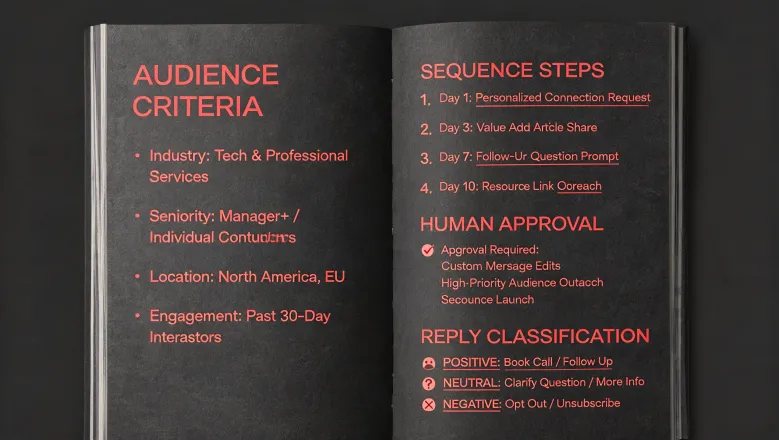
How does website visitor identification fit into an agent-native prospecting workflow?
It fits as the signal at the front of the loop. In an agent-native workflow, visitor ID tells your automation which accounts are already showing buying behavior, so the agent can enrich those accounts, verify their emails, and start a prioritized outreach sequence. It is not a standalone marketing toy. And if you treat it as one, you will pay for it twice. I know because I made a $6,400 mistake learning this.
I have been handling B2B sales prospecting operations for seven years. I have personally made, and documented, 11 significant mistakes totaling roughly $6,400 in wasted budget. This article is my checklist so you do not repeat them.
The $6,400 mistake: comparing monthly prices instead of total cost
In 2021, I built a growth stack the way most people do: I compared sticker prices. The LinkedIn automation tool was $49 per month. The email finder was $39. The website visitor identification tool was $79. The bulk email verifier was $29. Every price made sense on its own. Together, they cost almost $200 per month, before integration costs.
The integration broke in September 2022. My visitor tool flagged six companies as high intent. Our SDRs spent three days chasing them. Turns out two of those “companies” were our own office and a client’s internal team who were already in conversation with us. The tool was not lying; the pipeline was disconnected. We had no rules for deduplication, no enrichment, and no verification before outreach. The results looked like high intent, but the context was missing.
I said “connect the tools.” The developer heard “connect the APIs and let everything flow.” Result: duplicate records, wrong statuses, and a CRM that looked like a yard sale. That was the moment I stopped blaming software and started writing workflows.
What “agent-native” actually adds
An agent-native workflow is not the same as having a few Zapier connectors. It means the platform itself can act on data: when a visitor is identified, the agent enriches the account, finds the right contacts, validates their email addresses, and adds the account to the right sequence. No CSV exports. No manual handoff.
People think website visitor identification is a marketing feature for generating demand. Actually, it is a sales prioritization feature. The causation runs the other way: the tool does not make someone interested; it reveals who is already acting interested. In an agent-native loop, that revelation is the event that triggers everything else.
Total cost thinking: the only pricing math that matters
Let me make this practical. When someone asks about expandi pricing monthly, I tell them to stop at the sticker price. The right question is: what is the total cost of running this workflow for a year? That includes the monthly subscription, the time to maintain integrations, the data quality problems, and the cost of a bounced email campaign that damages your domain reputation.
I have seen a $49 tool cost $400 per month—or rather, $380, once you add the $79 visitor tool, the $39 enrichment tool, the $29 verifier, the Zapier subscription, and the hours of glue code. A platform that replaces three or four of those tools can look more expensive on the pricing page and still be the cheapest option in reality.
Why a bulk email verifier is a cost-control layer
A bulk email verifier sounds boring until your bounce rate hits 9.4%. That happened to us after we skipped verification to save $29 per month. We uploaded 2,000 contacts from an enrichment export. The agent sent emails to addresses that did not exist. Google and Yahoo postmaster guidelines do not care why your bounces are high; they just start filtering you. It took three weeks and about $900 in deliverability tools to recover.
A proper verifier checks syntax against RFC 5321/5322, looks up the domain’s MX record, and then does a safe mailbox check. If your tool only checks the format, it is not a verifier; it is a regex. In an agent-native workflow, this step should happen automatically before any message is queued.
A LinkedIn extension only helps if it feeds the same loop
I use a LinkedIn extension, but not for spray-and-pray connection requests. The job of the extension is to capture intent signals, like a profile visit or a comment on a post, and push them into the same prospect record that the agent works from. If the extension sits in a separate tab and exports a CSV, it is not an agent-native workflow; it is homework. The signal has to land in the same pipeline as the visitor ID data, the enrichment data, and the verification status.
Read the expandi API documentation before you commit
Feature checklists lie. API documentation does not. Before I chose the stack I use now, I spent an afternoon reading the expandi API documentation. I wanted to know three things: Can the API push visitor identification events into my CRM? Can enrichment return contact data in the same payload? Can verification status block an email send? When the answer is yes to all three, the monthly pricing becomes irrelevant, because you are replacing three separate subscriptions with one platform.
Here is the checklist I use now:
- List every subscription in the current workflow, including the ones with a free trial you forgot to cancel.
- Read the API docs before you compare features.
- Ask what happens to a website visitor identified at 2 a.m. Does an agent act, or does the lead sit until Monday?
- Count every CSV import. Each one is a place where the workflow dies.
When this advice does not apply
If you sell to twenty named accounts and have warm relationships, you do not need website visitor identification. You already know who you are pursuing. The signal adds noise, not priority. If your ICP is small businesses with under 100 employees, visitor identification is less reliable because owners browse from home IPs and shared networks. And if you operate in a privacy-sensitive industry, check whether de-anonymizing visitors conflicts with local regulations. I am not a lawyer, but I have learned to ask before building.
One more honest disclaimer: I do not believe anyone can guarantee LinkedIn account safety or 100% compliance with the platform’s terms. LinkedIn’s User Agreement limits scraping, and every good automation tool helps you reduce risk, not remove it. Once you accept that, you stop chasing magic and start building workflows that respect the rules.

Julian Hartwell
Julian Hartwell is an independent B2B sales intelligence analyst covering contact databases, company data, decision-maker profiles, direct dials, prospect lists, and buying signals. He applies the ISO/IEC 25012 data-quality model while examining field accuracy, coverage, freshness, duplicate rate, match confidence, and source transparency. His evidence-led guides help revenue teams compare prospecting platforms, define acceptable data thresholds, and build account lists that support reliable territory planning and outreach.