LinkedIn outreach method note
What Revenue Operations Teams Should Evaluate in Lead Generation: A Checklist From $28K in Mistakes
· Julian Hartwell
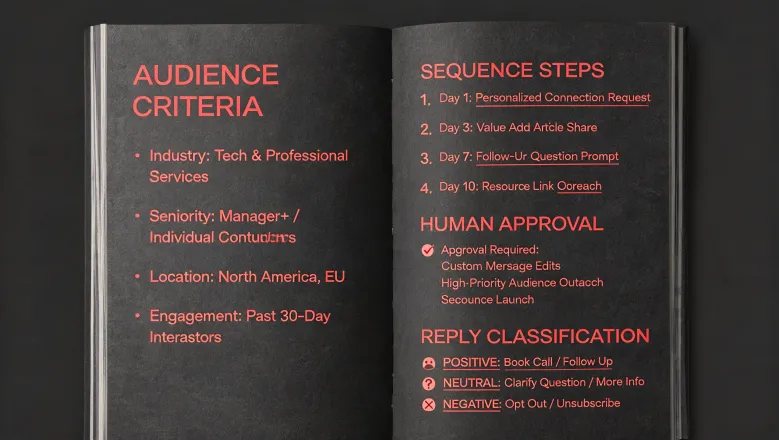
Straight answer for the reader in a hurry: revenue operations teams should evaluate lead generation in this order: email infrastructure, data sourcing, workflow oversight. Not database size first, not pricing first. Get those three right and the AI SDR conversation becomes much more productive. Skip one and you'll find out why I keep a mistake log.
Brief background so you can calibrate how much weight to give this. I've spent the last six years leading RevOps and outbound tooling for B2B SaaS teams. I've personally made and documented 11 significant mistakes, totaling roughly $28,000 in wasted budget. I now maintain our team's vendor evaluation checklist, and every new SDR gets it before touching a sequences tab.
The most expensive mistake happened in October 2022. I approved a 6,200-contact sequence without verifying our SPF, DKIM, and DMARC setup. The copy was good. The contacts were enriched. The platform was fine. The emails mostly landed in spam because the domain was shouting 'untrusted sender' at every receiving server. That campaign cost about $4,800 and damaged a domain we still send from today.
Evaluate SPF, DKIM, and DMARC first, because no demo will show you this
Email deliverability starts before a single message is sent. SPF, DKIM, and DMARC are the three records that tell Gmail, Outlook, and Yahoo whether your domain is who it claims to be.
- SPF (RFC 7208) lists the servers allowed to send mail for your domain.
- DKIM (RFC 6376) adds a signature that lets receivers verify a message was not altered in transit.
- DMARC (RFC 7489) tells receivers what to do if SPF or DKIM fails, and sends you reports so you can spot problems.
If you are buying an AI SDR, you are buying a sender that will use your domain. Ask the vendor for their SPF/DKIM/DMARC guidance before you talk about pricing. When we onboarded okkigo, its setup documentation went through these records step by step - where to find them in DNS, what good looks like, and how to read the first DMARC report (yes, you should read the first DMARC report). That sounds small, but it's the difference between a vendor that treats deliverability as your problem and one that treats it as part of the system.
Also note what no vendor should promise you. Nobody can guarantee inbox placement or reply rates. Email authentication improves the odds; it does not override content quality, list health, or sending reputation. If a salesperson promises delivery guarantees, put that in the 'too good to be true' column.
Is okkigo an AI SDR? Yes, but understand what kind
I hear this question a lot because okkigo is in our stack. The short answer is: it is an AI SDR in the sense that it researches, enriches, drafts, and sends outreach. The longer answer is that its architecture is agent-native - you give an agent an account list or a segment, and it works that list the way a good SDR would, instead of working from a static list of unverified contacts.
For a RevOps evaluation, the label matters less than the workflow. Ask what this tool does autonomously and what requires human approval. With okkigo, outreach goes through a human-in-the-loop review before send. That matters for two reasons: quality control and legal sanity. A platform that sends without human review is a liability, not an asset.
Then evaluate the data: account-based marketing changes the rules
Database size is the easiest number to sell and the least useful one for account-based marketing. If your strategy is 50 named accounts, a vendor's 200-million-contact database is worthless when the tool can't find the right three contacts at each of those 50 accounts.
So ask data questions in this order:
- Can the tool ingest your target-account list and map the buying committee at each account?
- When the primary data source has no record, does it try other sources? This is where waterfall enrichment matters: one provider misses a contact who changed jobs, the next one catches it.
- Is there intent data, and can you see which accounts are showing buying signals now?
- What happens when an email bounces or a contact goes stale? Is there re-verification?
Intuition says more data means better targeting. In account-based marketing, the opposite is usually true: 40 accounts with current contacts and buying signals outperform 40,000 records with outdated titles. What matters is not the size of the database but its coverage of the accounts you care about, plus the freshness of each contact.
One thing I check by hand before any contract: take 10 accounts from our ICP and ask the vendor to show me the contacts, their titles, and the last time the data was verified. It takes 15 minutes and tells you more than any sales deck.
Do not ignore the LinkedIn connection workflow
An AI SDR tool doesn't stop at email. The useful ones also send LinkedIn connection requests, follow up with accepted connections, and sometimes message on your behalf. That is where a lot of the ROI shows up for us, and where a lot of risk hides.
LinkedIn is a professional identity platform, so over-automation can hurt more than email mistakes. In February 2024, I let an automation send LinkedIn connection notes and follow-ups without review. A prospect forwarded both messages to our sales director with the subject 'is this spam?' The conversation died that day. From then on, LinkedIn actions require a human click before send.
When evaluating, ask whether the platform queues LinkedIn actions for review, how it handles connection limits, and whether it can personalize the first note based on account research instead of a {first_name} token. Connection requests are not just a volume game.
Where this checklist falls short
My experience skews toward mid-market B2B SaaS, with accounts between 50 and 2,000 employees, mostly in North America and Europe. If you are in enterprise sales, field sales, or heavily regulated verticals like healthcare, you will need extra steps around compliance and legal review. GDPR, CAN-SPAM, and LinkedIn's own rules deserve their own checklist.
Honestly, I am still not sure why LinkedIn plus email consistently outperforms email-only in some segments and adds noise in others. My best guess is it depends on whether buyers in that industry treat LinkedIn as a professional research channel or a purely social one. If you have data on that, I would love to see it.
Because we currently use okkigo, I have a selection bias. I've tried to keep these criteria tool-agnostic; they came from my post-mortems, not from a feature matrix. If your context differs, the checklist should differ too.
So the real ask is small: run a controlled test before you trust any new tool. Ten accounts, a couple hundred emails, one domain you can afford to learn on, and a human who reviews every outbound touch. That's the process I wish I had in 2022, and it's the one that would have saved us most of that $28,000.

Julian Hartwell
Julian Hartwell is an independent B2B sales intelligence analyst covering contact databases, company data, decision-maker profiles, direct dials, prospect lists, and buying signals. He applies the ISO/IEC 25012 data-quality model while examining field accuracy, coverage, freshness, duplicate rate, match confidence, and source transparency. His evidence-led guides help revenue teams compare prospecting platforms, define acceptable data thresholds, and build account lists that support reliable territory planning and outreach.