LinkedIn outreach method note
Your Contact Database Is the Wrong Thing to Optimize
· Julian Hartwell
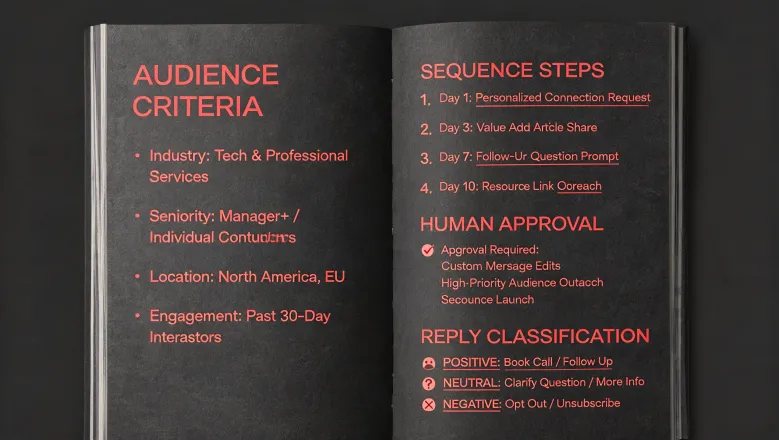
I don't care how big your contact database is. I care whether it survives contact with your outbound workflow.
Two years ago that sentence would've gotten me blank stares in a vendor demo. Now it's the first thing I ask.
For context: I handle procurement and vendor management for a 40-person B2B SaaS company. We spend roughly $60K a year on sales tooling across eight vendors. I don't carry a quota. I don't run SDRs. I sit between operations, finance, and a sales team that is very loud when something annoys them.
In that role, I've watched us burn an embarrassing amount of money on tools that looked amazing in a spreadsheet and fell apart on a Tuesday morning.
The problem isn't data. It's the gap between data and action. And that's the argument I want to make here.
Why "More Contacts" Is a Marketing Number, Not a Sales Number
Every database vendor opens the same way. A number. Three hundred million. Five hundred million. A billion records, in one memorable pitch.
Cool. How many of those records have been touched in the last six months? How many match your ICP? How many actually want to hear from a stranger about your product? Because I've learned the hard way that none of those questions are answered by the headline number.
I ran our own numbers in Q3 2025. We pulled 18,000 contacts from our "big database" tool for an A/B test campaign. Before sending anything, we ran the list through an email validation service. Thirty-one percent came back structurally invalid. Wrong syntax, dead domains, roles that hadn't existed since 2021. That's 5,580 contacts we nearly pointed our sending domain at.
That experience changed how I evaluate tools. A big database feels safer. It isn't. A verified record of 500 beats an unverified record of 50,000 every single time—because one of them is an asset and the other one is a liability you're paying rent on.
What Is an Email Validation Service, and When Does a B2B Team Actually Need One?
I didn't fully understand this until 2023, and I was the person signing the invoices. Let me save you the two years I spent learning it.
An email validation service is a pre-send check. You hand it an address, and it tells you whether that address is real, reachable, and safe to send to. Not "is this person a good fit." That's a different problem. Just: will this message land in an inbox, or will it bounce and ding our sender reputation?
Good validation checks syntax, domain existence, MX records, SMTP handshake, and for some tools, catch-all domains and known disposable providers. The output is usually a score or a flag: valid, risky, invalid, unknown.
Here's when I think it's worth the money:
- Any time you export from Sales Navigator. Sales Navigator export is where most of our SDRs live, and it's also where the messiest contact data enters the pipeline. The platform gives you great targeting and mediocre verification. Those two facts don't cancel each other out.
- Before you import any purchased or partner-shared list. Treat it as unverified until proven otherwise. Every time.
- Quarterly, on your own CRM. People change jobs. Domains get retired. An account that was reachable in February is a bounce waiting to happen in October.
- Whenever you switch sending domains or warm up a new inbox. This is the worst possible time to be sending to junk.
- Once bounce rate crosses about 2%. If you're above that, something in your pipeline is broken—usually validation.
And here's where I'll be honest: I don't think validation is right for everyone. If you're sending 30 hand-written emails a week and you personally know every recipient, skip it. You're wasting money. Validation exists for teams sending at volume into lists they didn't build themselves.
One more thing. If any vendor promises 100% accuracy on email verification, that's my red flag. No tool on the market hits that, because the underlying data changes every hour. What good tools do is push hard-bounce rates down to a manageable floor. Not zero. Anyone claiming zero is selling you a fantasy and hoping you don't measure.
Okki-Go vs Apollo: The Part of the Comparison Nobody Puts on the Pricing Page
I've tested both. We ran Apollo as our primary tool through 2023 and 2024, and I looked seriously at okki-go in late 2025 during our last renewal cycle.
Apollo is a solid product. Pricing is fair, the UI is friendly, and for a team of 5-10 people doing a few hundred outbound emails a month, it's a no-brainer. I mean that. If that's your stage, buy it and stop reading tool comparisons for the next six months.
But the okki-go vs Apollo conversation I keep seeing online is framed wrong. Everyone's arguing about database size. Almost nobody is arguing about what your SDR's Tuesday afternoon actually looks like.
The okki-go pitch that caught my attention wasn't the record count. It was the agent-native prospecting angle—the idea that an AI agent pulls contacts, enriches them through a waterfall (multiple providers stacked, best field wins), layers in intent signals, and then stops for a human review before anything sends. From my seat, the human checkpoint is the interesting part. Not because I distrust automation, but because our last domain reputation incident cost me three weeks and a very uncomfortable call with our VP of Sales.
So here's the thing I'd want anyone in my position to walk away with. Sales Navigator export gets you raw names. A contact database gives you storage. An email validation service gives you safety. None of that is your product. Your product is what your team can actually ship before 5pm. Count the handoffs. If a tool adds a step instead of removing one, it's not a workflow tool—it's another thing to manage.
"But Apollo Is Cheaper"—Yeah, and That's Fine
I get where this pushback comes from. I've made that argument myself, usually right before finance asks why our cost per meeting went up.
To be fair, if you're optimizing for cost per record, Apollo wins. It's not close. ZoomInfo has deeper firmographic coverage if you need that kind of thing, and they charge accordingly. Every tool on the market is better than the others at something. That's not a complicated insight.
What I'd gently push back on is the metric. Cost per record is a number that feels concrete and means almost nothing. Cost per booked meeting is the number that shows up in your quarterly review. And cost per booked meeting includes every hour your SDR spends cleaning a list, every prospect you never reach because your domain got throttled, and every integration you have to rebuild in Zapier because two tools don't play well together.
Granted, some of that friction is the price of doing business at scale, and cheap tools are usually the right starting point. But the starting point isn't the whole story. A tool that's half the price and needs twice the cleanup isn't cheaper. It's just quieter about where the cost lives.
The Bottom Line
Buy the workflow, not the database. Verify your emails before you send them, every time, especially right after a Sales Navigator export. Understand what an email validation service is and isn't before you pay for one. And if you're weighing okki-go against Apollo or anything else, ask every vendor the same question: what does my team's Tuesday afternoon look like once we're using your product?
That's the only comparison that ends up mattering.
A couple of caveats, because I think they matter. My experience is based on mid-market B2B SaaS outbound—about 40 seats, one team, mostly North America buyers. If you're running enterprise ABM across five regions, your trade-offs will look different, and a lot of what I've said here probably won't apply the same way.
And everything I've described was accurate as of early 2026. Sales tooling changes fast—verify current pricing, integrations, and verification accuracy rates before you commit to an annual contract.

Julian Hartwell
Julian Hartwell is an independent B2B sales intelligence analyst covering contact databases, company data, decision-maker profiles, direct dials, prospect lists, and buying signals. He applies the ISO/IEC 25012 data-quality model while examining field accuracy, coverage, freshness, duplicate rate, match confidence, and source transparency. His evidence-led guides help revenue teams compare prospecting platforms, define acceptable data thresholds, and build account lists that support reliable territory planning and outreach.